Showing posts with label search engine. Show all posts

Aug 14, 2010

The Value of Google Result Positioning

Source: Chitika 

How much is the top spot on Google actually worth?  According to data from the Chitika network, it’s worth a ton – double the traffic of the #2 spot, to be precise.

In order to find out the value of SEO, we looked at a sample of traffic coming into our advertising network from Google and broke it down by Google results placement.  The top spot drove 34.35% of all traffic in the sample, almost as much as the numbers 2 through 5 slots combined, and more than the numbers 5 through 20 (the end of page 2) put together.

“Obviously, everyone knows that the #1 spot on Google is where you want to be,” says Chitika research director Daniel Ruby.  “It’s just kind of shocking to look at the numbers and see just how important it is, and how much of a jump there is from 2 to 1.”

The biggest jump, percentage-wise, is from the top of page 2 to the bottom of page 1.  Going from the 11th spot to 10th sees a 143% jump in traffic.  However, the base number is very low – that 143% jump is from 1.11% of all Google traffic to 2.71%.  As you go up the top page, the raw jumps get bigger and bigger, culminating in that desired top position.
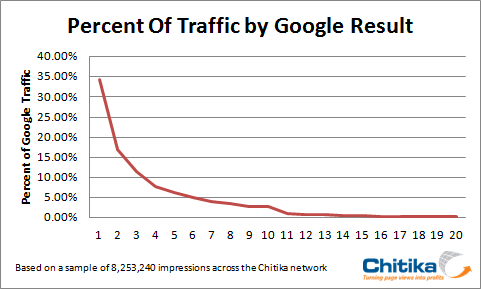
Traffic by Google Result
Google Result Impressions Percentage
1 2,834,806 34.35%
2 1,399,502 16.96%
3 942,706 11.42%
4 638,106 7.73%
5 510,721 6.19%
6 416,887 5.05%
7 331,500 4.02%
8 286,118 3.47%
9 235,197 2.85%
10 223,320 2.71%
11 91,978 1.11%
12 69,778 0.85%
13 57,952 0.70%
14 46,822 0.57%
15 39,635 0.48%
16 32,168 0.39%
17 26,933 0.33%
18 23,131 0.28%
19 22,027 0.27%
20 23,953 0.29%

Numbers are based on a sample of 8,253,240 impressions across the Chitika advertising network in May, 2010.


Aug 13, 2010

Email, portals stay ahead of social networking—at least on mobile devices

AUGUST 13, 2010

Social networking has become such a staple of online activity in the US that, according to Nielsen, internet users spent more time on social networking sites and blogs than doing any other activity in June 2010. Games, which came in second, took up less than half as much time.
On the mobile internet, however, more traditional activities still reign. Email dominated the mobile picture even more strongly than social networking did the desktop: If all time spent on the mobile web was condensed into a single hour, US internet users would have spent 25 minutes in June checking email. Portals would have received another 7 minutes, with social networks not far behind.

Time Spent* on Mobile Internet Activities by US Internet Users, June 2010 (mins:secs)

Nielsen reported that social networking has been closing the gap in time spent on the mobile internet, gaining share since last year as portals dropped in importance over the same period.
But email remains one of the most popular mobile internet activities not just by time spent but also by penetration. According to the Pew Internet & American Life Project, 34% of all US mobile subscribers used email on their phone in May 2010, compared with 23% who used a social networking site.
comScore also reported mobile email usage via a browser ahead of social networking. That research found search had the highest penetration of any mobile browsing activity, but search is less time-intensive than email or social sites.

Leading Categories for Mobile Browsing Among US Mobile Subscribers, Mar 2010 (% of total mobile subscribers)

Social should continue to make gains in the mobile realm, however. comScore reported it was the fastest-growing mobile internet activity between 2009 and 2010, rising 80% in usage, while email grew more slowly. Bridge Ratings predicted in June that mobile social networking would grow twice as quickly as email during the next 12 months.
The growing penetration of smartphones will be a key factor in increased mobile social networking. According to comScore, 53% of smartphone users participated in social networking activities on the go, compared with just 11% of feature phone owners.
Keep your business ahead of the digital curve. Learn more about becoming an eMarketer Total Access client today.
Check out today’s other article, “Strategies to Help Retailers Prep for Holiday Success.”

Apr 15, 2010

Google has Twitter timeline search

by Jay Hathaway (RSS feed) Apr 14th 2010 at 3:02PM
Google's venture into real-time search just got a lot more serious, with a new Twitter timeline feature. Like Twitter's own search, Google's Twitter timeline can tell you what people are saying about your search term right now. Google's done one better, though, by indexing tweets back to the beginning of time (well, the beginning of Twitter, anyway), and displaying an activity graph that shows you when tweets about your topic spiked.

The implications of indexing every tweet and making them all searchable are pretty huge. I'm excited to be able to go back and find some of the funny tweets I wrote a couple of years ago, but you might not be excited that people can find all the mean things you said about your boss before he discovered Twitter. Don't worry, though, deleting a tweet will wipe it out of Google's results, too.

It's interesting that Google made this move the day after Twitter announced Promoted Tweets on its search page. Can you use Google to skip Twitter's search and thereby skip its ads? On the other hand, it makes sense to launch a new Twitter feature on the opening day of Twitter's Chirp Conference for developers. It'll give them something to talk about in San Francisco.

[via CNET]


Don't miss a thing! Free update by email. Enter your email address:

Dec 28, 2009

400% Rise in Social Media Traffic due to Search Engines


Posted by Marshall Sponder on December 26, 2009


It’s Google that’s driving Social Media searches way, way, up – see my last post on 400% Rise in Social Media Searches in 2009 Y2Y – what does it mean?


Note: Just want to point out this “hunch” of mine about Google driving Social Media searches and traffic needs a more “deep dive” analysis to confirm.   My “hunch” is, I’m right – and if you look at the entire history of what’s happened this year with Social Media, Google, Bing and Yahoo! have their hands all over it …. especially the latter part of this year  – that confirms my “hunch”.
Still, as a Web Analyst – I feel a responsibility to confirm my hunch with real data beyond what I’ve shown.  Had I access to Comscore – I might have an easier time of it – the real data I need is not that easy to get a hold of …. I suspect, if I had it …. it would more or less, confirm what I believe, which is  … it’s the deals that Twitter and Facebook have done with Google that are driving up Social Media and will continue to accelerate in 2010.


I think it’s about Google and Real Time Search – the inclusion of updates from Twitter and Facebook are the main drivers – but the overall direction is for a full integration between Search Engines and Social Media next year.


Very interesting recap of developments in Social Media this year from WebProNews which tie into the 400% increase in searches and activity on Social Media in the second half of 2009.
Google’s  inclusion of real time data from Twitter and now Facebook – is beginning to deliver the “promised land” and  made Social Media the “mecca” the “goldmine” that it is … it’s Google, as I predicted long ago – would bring Social Media, via Search, into it’s own – it’s Google and the Search Engines that will make 2010 the year of Social Media ROI and the beginning of the Convergence.
While the buildup has been gradual, according th the Google Insights for Search chart – the real action started happening in July 09 and has been building up momentum ever since.

Google Insights for Search
Gadgets powered by Google


Here’s what happened according to WebProNews – What’s Happened in Social Media Over the Year and I’ll bold the parts I think are the most significant.
July
In July, Google launched its Facebook page, MySpace launched its email service, and LinkedIn introduced custom profiles for companies. YouTube launched its 3D experiment, doubled the size limit of uploads, and gave users the ability to share YouTube Insights stats.
A Twitter documentary was announced, and Twitter itself gave businesses a new resource and started making hashtags link. Facebook addressed privacy and photo use for ads, gave businesses a way to increase their Facebook fans, and added the ability to create events from the publisher.
August
In August, Facebook was readying a new ads manager, made subtle changes to its design, announced plans for privacy improvement, started integrating directly with Twitter, launched its own real-time search, implemented restrictions on sponsored status updates, updated open stream APIs, acquired FriendFeed, and began letting developers sell physical merchandise for virtual currency.
Twitter quietly took a step toward security, and announced plans to launch a feature that makes the service location-aware. Izea launched “Sponsored Tweets,” andTweetmeme brought analytics to retweeting.
Google reader got more social features, YouTube placed more emphasis on search and launched its own AdSense-like promoted videos. Delicious showed off new features forsharing, search, and its homepage. StumbleUpon made some big changes to its toolbar.
September
In September, Google turned the whole web into an exclusive social network with SideWiki. Yahoo launched a new contacts API, Yahoo profiles became social media profiles, and the company launched the Twitter-like Yahoo Meme in English. Microsoft added MySpace activity updates to Windows Live, and Bing announced it was readying sharing features for search results.
A sick poll was discovered on and removed from Facebook, and Facebook announced its translation plans, and that it had roughly the same amount of people as the entire U.S. population. Facebook also added tagging from status updates, and launched Facebook Lite in the U.S. and India.
MySpace Music launched in Australia, and Myspace users started being able to sync updates with Twitter. LinkedIn made profile organization easier, a record label was launched for YouTube stars, and YouTube began readying a friend-finder feature.
Pizza Hut and other brands used Twitter to help feed the hungry, Digg made changes to its nofollow policy, the Washington Post’s leaked social media policy faced criticism, and real-time search engines Collecta and OneRiot launched APIs.
October
In October, Bing scored deals with Twitter and Facebook, while Google scored one with Twitter. Mozilla shared its plans for integrating social media and email into one inbox, and Twitter partnered with its first charity. LinkedIn announced that it surpassed 50 million users.
MySpace introduced new music features, StumbleUpon launched a new design with more of a search focus, YouTube got real-time search for comments, and the only known video footage of Anne Frank appeared on YouTube.
Facebook confirmed testing of a new design, made share buttons more useful, gave groups walls, tried harder to get page owners to verify, and presented new obstacles for application developers. They also launched the Create Application API.
November
In November, Google eased the retrieval of SideWiki entries for entire sites, Google Wave got a feature for following, and Google launched some new features for Google Friend Connect.
Facebook tested new design changes, and continued work on privacychanges. Facebook and Twitter both made their way into dictionariesand onto video game consoles.  Twitter made geotagging tweets possible, and talked about plans which would make its suggested usres list more like Twellow’s. Twitter also changed launched Twitter Lists, gave apps access to people search, rolled out the controversial retweet feature, and changed “What are you doing?” to“What’s Happening?”.
LinkedIn opened up its platform to developers, Yahoo began showing tweets for news results, MySpace launched new music charts, Salesforce announced its “Facebook for the enterprise,” YouTube connected news outlets with citizen reporters, PayPal launched new APIs to take over mobile and social apps, Microsoft launched a big redesign of MSN, Opera launched Opera Unite, Digg launched Digg Trends.

December

In December, Google, Facebook, and YouTube all got new URL shorteners. Twitter continued expansion into new languages, and announced plans for business features. Google launched real-time search in the search results.
LinkedIn began testing a new design, and launched faceted search, Facebook began giving translators awards, adjusted privacy controls, and formed a board for online safety, MySpace launched new APIs, upgraded users’ mobile experience, and acquired iMeem, Bing launchednew maps with apps, and Yahoo deepened its integration with Facebook. Digg released a new version of its API. Also, the new FTC guidelines went into effect.
It’s mostly Google – Google has been merging the Social Web with Organic Search and now….


Compete.com Destination Traffic from Google.com, November 09

…. Social Media goes mainstream in 2010 – it’s said to be the year of Social Media ROI, so many say ….. I think if we’re not there by years end 2010, we’ll be much closer to it  – you can see the acceleration.
I’m developing a deck around this – but felt I didn’t want to wait to share the news – and perhaps, get insight from my readers that I can use  (I don’t get the whole picture – but I don’t know anyone who does – but, maybe, together – we can make sense of all of this).


Read more: http://www.webmetricsguru.com/archives/2009/12/400-rise-in-social-media-traffic-due-to-search-engines-google/?utm_source=feedburner&utm_medium=feed&utm_campaign=Feed%3A+WebMetricsGuru+%28WebMetricsGuru%29&utm_content=Google+Reader#ixzz0ax7XFekV
Under Creative Commons License: 
Attribution