- Facebook announced that in addition to the U. S. and UK, Facebook users in Australia, Canada, India, Ireland, New Zealand and South Africa can now access the App Center via the left-hand side of the News Feed as well as in Facebook’s apps for iPhone, iPad and Android devices.
- Facebook’s App Center launched in the U. S. early last month.
- Conveniently, if users select an app while browsing in the App Center, they can opt to be reminded to install the app the next time they turn on one of their mobile devices.
Showing posts with label facebook. Show all posts
Jul 18, 2012
Facebook App Center launch more countries
Posted on Wednesday, July 18, 2012 by Hai Le
Jan 1, 2011
Nov 30, 2010
China’s Social Network Personalities
Posted on Tuesday, November 30, 2010 by Hai Le
The Social Media team for Ogilvy Beijing created this great graphic to explain the personality differences between social networks in China. Unlike other parts of the world, where Facebook or other social networks dominate, Chinese users tend to join with their peers from a similar background.


Trackback URL for this post:
http://www.thomascrampton.com/china/chinas-social-network-personalities/trackback/
Nov 27, 2010
When your Relationship Will End
Posted on Saturday, November 27, 2010 by Hai Le
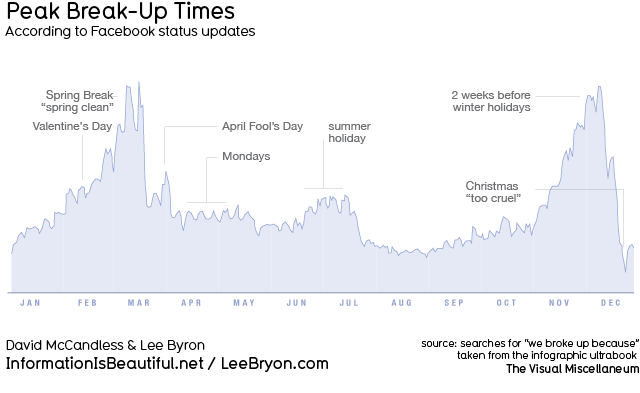
Have you ever wondered when people break up? Look at the graph below.
I watched a TED talk the other day from David McCandless called “The beauty of data visualizations“. It was quite amazing and included lots of different datasets. One of them was about Facebook and breakups. David and his team scanned over 10 000 status-updates and set out to learn more about when people broke up. This is what they learned:
- A big peak right before Spring Break
- Most breakups are announced on Mondays
- People like to start the summer being single
- A big peak right before Christmas
- The lowest day throughout the whole year is Christmas Day (thank God)

I never stop being amazed about how much Facebook can actually teach us about human behavior. When everything is being digitalized and searchable, some really interesting stuff appears
Nov 20, 2010
History of Social Media
Posted on Saturday, November 20, 2010 by Hai Le
By the Numbers: Facebook vs. Zynga
Posted on Saturday, November 20, 2010 by Hai Le
Facebook and Zynga, two of the largest social web companies, have been at odds recently. Zynga is one of the biggest buyers of advertising on Facebook, and without Facebook, Zynga would struggle to grow.
In other words, the two can’t live without each other. But cooler heads have prevailed and they’ve now settled their differences and inked a 5-year truce. We’ve put together a graphic that lays out the details of their codependency.
Update: Please note that this corrects an earlier version in which the use of Facebook Credits for games was described as “exclusive;” it was not. It also corrects the month in which Facebook removed third-party notifications for Farmville.
Related content from GigaOM Pro (sub req’d):
Oct 31, 2010
A Graphic Guide to Facebook Portraits
Posted on Sunday, October 31, 2010 by Hai Le
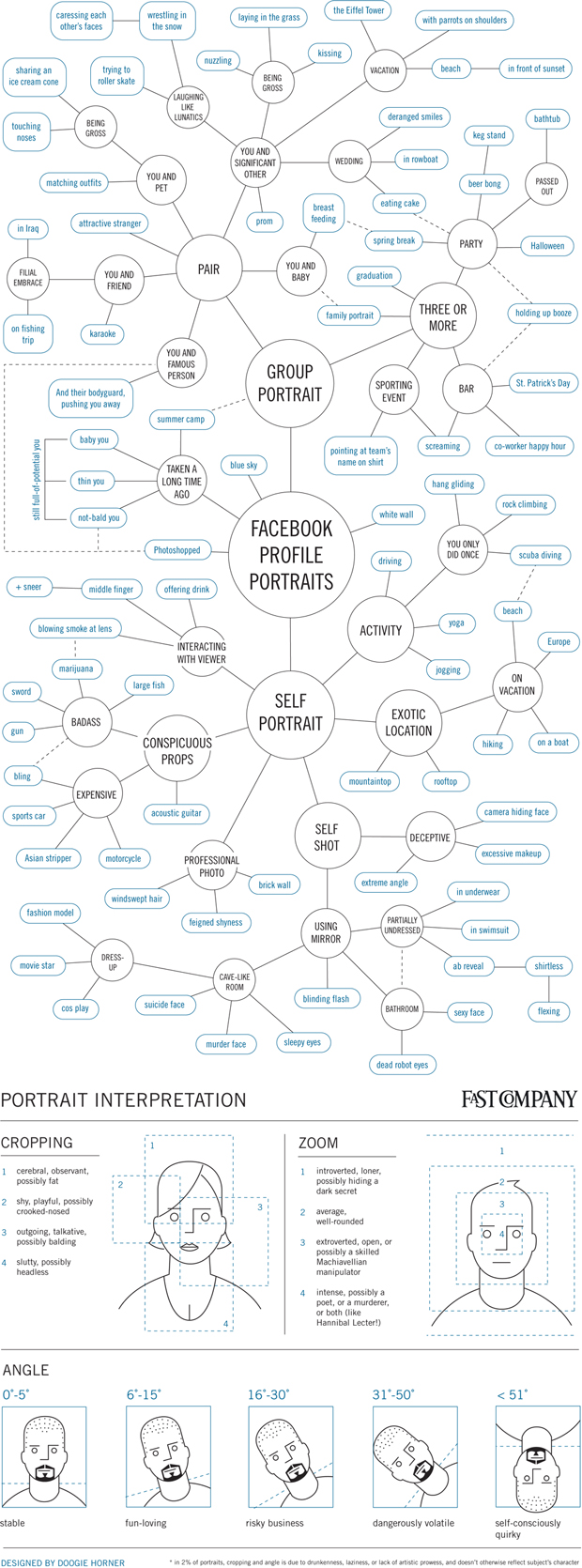
As a new strain of Social Network fever infects the nation, and you finally decide to share your face with the world, get the lay of the virtual land with our own open graph of portrait types.

Everyone is aware of how significantly Facebook has impacted modern technologies such as online communication, information aggregation, and boyfriend stalking. Less noticed, but just as profound, is its influence on art. Just as refinements in mirror crafting led to an increase in self portrait production during the Renaissance, Facebook's steady, unrelenting invasion of every crevice in the civilized world has led to a new renaissance in portraiture, notable for its creation by people who wouldn't know good art if it friend requested them.
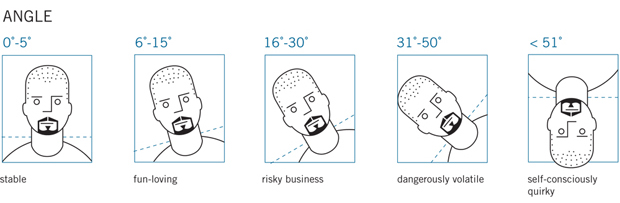
These office workers and bored teens have replaced Okies and deranged shut-ins as the ultimate outsider artists; not only do they lack formal artistic training, most lack even the desire to create art. However, with this humble, ad hoc genre a complex visual dialogue has emerged, and its unique vocabulary reveals much about the modern world. Like all art forms, Facebook portraiture has its own lazy tropes—the laptop camera shot, the blue sky background, the blinding flash in a bathroom mirror—but even these thoughtlessly captured snapshots yield unintended insights about their subjects: How is the photo cropped? Can we see the subject's abs? Why is she giving us the finger? (See Portrait Interpretation key below.)
This chart will hopefully help you view specific Facebook portraits within the context of the larger genre, and therefore lead to a richer, more complex appreciation of Facebook portraiture as an emerging form of banal, eye-numbing expression.
NOTE: Choosing a literal or figurative avatar for your Facebook profile—a cartoon drawing, a famous person you think you look like (but which you don't), a flower, a beach—is a popular option, but since it isn't portraiture in the traditional sense, it is not covered in this chart.
Doogie Horner is the author of Everything Explained Through Flowcharts (Harper Collins, 2010) and Dirty Jokes Every Man Should Know (Quirk, 2009).
Oct 16, 2010
Shanda Launches Candy: A mashup of Twitter, Facebook, and Foursquare
Posted on Saturday, October 16, 2010 by Hai Le
Candy (Tang Guo / 糖果) mixes microblogging, social games, and badges, a mashup of Twitter, Facebook, and FourSquare. While most social networks are scaling back social games to focus on real friends (e.g., Facebook, RenRen, and Kaixin001), Shanda’s Candy embraces games (with a semi-open platform) and nicknames.It’s almost cliché for Chinese internet giants to launch a microblog or social network; nearly all have tried. The challenge for Candy (in Beta) is to gain initial traction and to achieve user retention. The latter could be challenging for such a casual site, there’s a reason the other social networks are moving away from that model.
Candy reflects Shanda’s effort to diversify into casual games. Over 86% of Shanda’s 768 million USD in 2009 revenues came from Massive Multiplayer Online Role Playing Games (MMORPGs), while casual games accounted for just 12% of revenue. As Shanda’s bread-and-butter MMORPGs like Woool and Mir 2 age, it is imperative that the firm finds new hits or market models.
One analyst recently downgraded Tencent, which derives 48% of its revenue from online gaming, over concerns about a slowing MMORPG market:
We believe social network games are competing against MMO games for users’ time. Chinese Internet users now have more diversified entertainment means than before, causing high-monetization MMO games to lose growth momentum.
As the name implies, Candy is cute and bubbly—perhaps sweeter for girls than guys. The closest analog is Qzone by Tencent, which also mixes nicknames, cuteness, and games, although that site suffers from poor execution.
At the core of the site is a microblog that allows for far richer interaction than Twitter. The character limit is a generous 256 (almost an essay in Chinese), comments are threaded, and pictures, videos and emoticons can be attached.
Users also gain badges for sharing, playing, and friending.
Candy offers 33 applications (17 are games), including a few from 3rdparties. Production quality of the applications is high: the graphics are attractive and the functions are simple and intuitive.
All applications are pre-installed with square logos in the style of the iTunes Store. The design team closely followed the hottest in Western tech and design, while still adding elements familiar to Chinese netizens: a cute design, emoticons, and footprints.
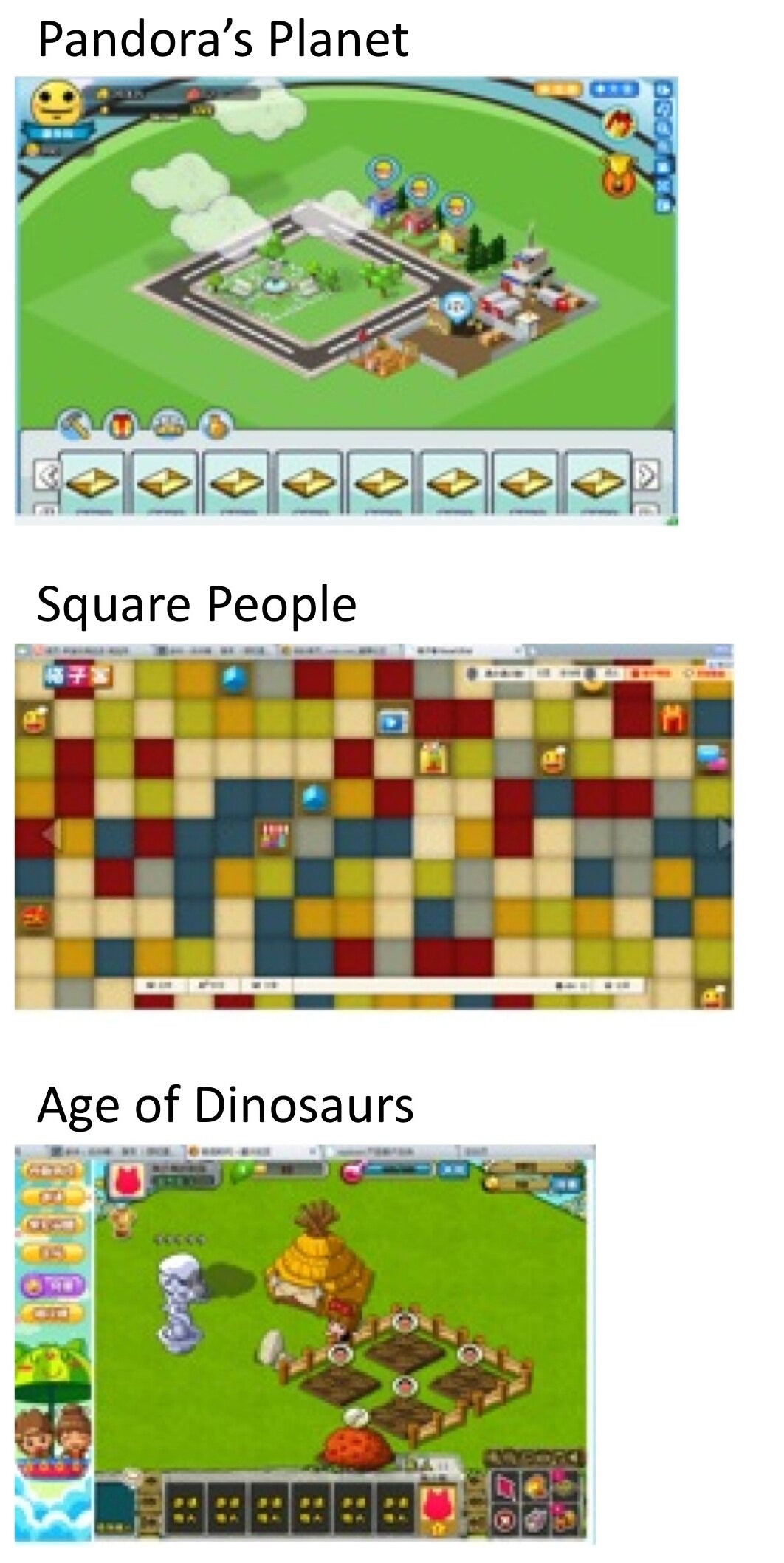
New applications include:
- Pandora’s Planet (by Shanda): a simplified version of Sim City, in which players strive to expand their city.
- Square People (格子客, by Shanda): Players flip over a square to discover a surprise task or video behind it (e.g., add person x as a friend).
- Age of Dinosaurs (by Shanda): A farm game with a dinosaur theme that encourages more interactions between users. Prayer ceremonies can ward off dinosaur attacks.
- 3rd party applications include a music player (Xiami), video player (Ku6), and the popular social game Bubble Fish (泡泡鱼), which is also found on the RenRen network.
Shanda’s star MMORPG Mir 2 (传奇世界) is also an application (though it’s not yet operational), indicating an attempt to bridge the gap between MMORPG and casual gamers. That’s a big divide to bridge, but success would be sweet—and lucrative—for Shanda.
Kai Lukoff is an analyst at BloggerInsight and an editor on China Social Games. Follow Kai on Twitter @klukoff
Kai Lukoff is an analyst at BloggerInsight and an editor on China Social Games. Follow Kai on Twitter @klukoffAug 23, 2010
Google Winning Sign-In War, But Facebook Close Behind
Posted on Monday, August 23, 2010 by Hai Le
By Mathew Ingram Aug. 17, 2010, 8:01am PDT
Most website users still prefer logging in with a Google account, but Facebook is a close second, according to new data from Janrain, a Portland startup whose software plugin makes it easy for websites to offer multiple login methods. The company’s latest survey looked at statistics from more than 250,000 websites and services that use its software, and found that close to 40 percent of users prefer to sign in with a Google ID, while 24 percent chose to login with their Facebook profile. Yahoo came in third with 14 percent of sign-ins, while Twitter and Microsoft’s Windows Live were tied at 5 percent.

It’s not all that surprising to see Facebook and Google ahead of Twitter, since much larger numbers of people use the social network and various Google services than are likely on Twitter, but it’s interesting that Microsoft’s Windows Live — which has been around for years, and was designed to be a single sign-on solution for the web long before Facebook came along — has such a tiny proportion of login activity, at least according to Janrain’s data (meanwhile, MySpace, AOL and LinkedIn are lumped together in the “other” category). The company said that the stats have not shown much change from April, when it last looked at its overall login data.
Janrain also broke down logins based on the type of website or service users were logging into as well, and that data shows Yahoo in the lead with 34 percent of logins to news and media-related sites, and Facebook in second place with 28 percent. Google comes in third with 25 percent, and AOL has 10 percent — which may seem like a large number, but isn’t that surprising given the fact that it is closely tied to the media properties of former parent company Time Warner (Gigya, meanwhile, found that Twitter was the number one login method at news sites, with 45 percent of sign-ins, while Facebook came second with 25 percent).

Janrain said that its data showed Facebook well in the lead when it comes to logins for music-related sites, with 55 percent of sign-ins, while Twitter was second with 18 percent. Facebook was also the number one login method for websites involving retail brands, Janrain’s study showed, with 45 percent of logins. Yahoo was in second place with 23 percent and Google came third with 21 percent. Facebook was also the number one choice for logging in to European websites, the company said — it had 39 percent of sign-ins, with Google coming in second at 26 percent and Twitter at 12 percent.
The company’s numbers also showed that Facebook is the leading service when it comes to sharing links to websites, thanks to its ubiquitous “like” buttons, with 53 percent of users choosing to share their activity on the social network — but Twitter is a strong second place with 37 percent.

Most website users still prefer logging in with a Google account, but Facebook is a close second, according to new data from Janrain, a Portland startup whose software plugin makes it easy for websites to offer multiple login methods. The company’s latest survey looked at statistics from more than 250,000 websites and services that use its software, and found that close to 40 percent of users prefer to sign in with a Google ID, while 24 percent chose to login with their Facebook profile. Yahoo came in third with 14 percent of sign-ins, while Twitter and Microsoft’s Windows Live were tied at 5 percent.

It’s not all that surprising to see Facebook and Google ahead of Twitter, since much larger numbers of people use the social network and various Google services than are likely on Twitter, but it’s interesting that Microsoft’s Windows Live — which has been around for years, and was designed to be a single sign-on solution for the web long before Facebook came along — has such a tiny proportion of login activity, at least according to Janrain’s data (meanwhile, MySpace, AOL and LinkedIn are lumped together in the “other” category). The company said that the stats have not shown much change from April, when it last looked at its overall login data.
It’s worth noting that the numbers reported by Janrain are substantially different from those recently provided by Gigya, another service that offers multiple logins for websites. Gigya found that Facebook was the number one login method at all of the sites it covers, with 46 percent of logins, while Google came a distant second with 18 percent. It’s not clear how many websites or services Gigya’s data was based on, or what explains the discrepancies between the two surveys.
Janrain also broke down logins based on the type of website or service users were logging into as well, and that data shows Yahoo in the lead with 34 percent of logins to news and media-related sites, and Facebook in second place with 28 percent. Google comes in third with 25 percent, and AOL has 10 percent — which may seem like a large number, but isn’t that surprising given the fact that it is closely tied to the media properties of former parent company Time Warner (Gigya, meanwhile, found that Twitter was the number one login method at news sites, with 45 percent of sign-ins, while Facebook came second with 25 percent).

Janrain said that its data showed Facebook well in the lead when it comes to logins for music-related sites, with 55 percent of sign-ins, while Twitter was second with 18 percent. Facebook was also the number one login method for websites involving retail brands, Janrain’s study showed, with 45 percent of logins. Yahoo was in second place with 23 percent and Google came third with 21 percent. Facebook was also the number one choice for logging in to European websites, the company said — it had 39 percent of sign-ins, with Google coming in second at 26 percent and Twitter at 12 percent.
The company’s numbers also showed that Facebook is the leading service when it comes to sharing links to websites, thanks to its ubiquitous “like” buttons, with 53 percent of users choosing to share their activity on the social network — but Twitter is a strong second place with 37 percent.

Aug 13, 2010
Facebook Ad Sales to Hit $1.2 Billion This Year
Posted on Friday, August 13, 2010 by Hai Le
NEW YORK (AdAge.com) -- With its more than half billion users and privately-held status, Facebook's revenue has long been a favorite guessing game for observers from Silicon Valley to Wall Street. But a new estimate from eMarketer says the company will book $1.285 billion in global advertising alone this year, almost double the estimated $665 million the company took in last year. That figure doesn't include Facebook's so-called virtual currency trade, which would nonetheless account for a fraction of the company's overall business.

The eMarketer analysis stands as a significant third-party verification against some of the provisional numbers floating around in the media. A July Bloomberg article, for example, cited two anonymous sources indicating Facebook would book $1.4 billion this year. A March report from the Wall Street Journal pegged the company's 2010 revenue at a wide range of $1.2 billion to $2 billion, also citing anonymous sources. In both articles, it was unclear whether the information came from inside or outside the company itself.
Like Google, Facebook's self-serve advertisers are largely local, coming from marketing dollars once spent on yellow pages listings. If those advertisers perform anything like Google's, they won't be as cyclical as national brand advertising, giving Facebook a buffer against future ad slumps.
Naturally, the other half of Facebook's revenue comes from display advertising, which the company recently ramped up after Microsoft's deal to sell Facebook's banner advertising ended in February. The site now serves all its own uniquely sized units; they are smaller and come at a lower price point. That may also explain, despite their hefty revenue, the very low average ad rate of 56 cents for every 1,000 impressions Facebook brings in, compared to the $2.43 average for the internet at large.
In part driving those bottom-dollar ad rates is the fact that Facebook accounts for a significant percentage of all display ad impressions on the web -- 16.8% of all impressions the U.S. in May, according to ComScore. That makes Facebook responsible for almost a fifth of all ad traffic in the country.
While Facebook is ramping up ad revenue, MySpace can barely hang on to the budgets that remain. The News Corp.-owned social site stands to bring in $347 million this year, a 26% drop from the estimated $470 million from last year, according to eMarketer. Further, its going to get worse before it gets better: EMarketer estimates MySpace will come in under $300 million in 2011. The ailing company recently hired ad agency Pereira & O'Dell for its first consumer brand campaign this fall.

Facebook did not return calls seeking comment.
Apr 24, 2010
I Think Facebook Just Seized Control Of The Internet
Posted on Saturday, April 24, 2010 by Hai Le
by MG Siegler on Apr 21, 2010

The opening keynote at Facebook’s f8 conference today in San Francisco was short and sweet. But don’t let that fool you. It contained some huge announcements pertaining to how the service will interact with the broader web going forward. The three big ones: social plugins, Open Graph, and Open Graph API, make Facebook’s intentions very clear: they want to be the fabric of the web.
Erick already outlined Facebook CEO Mark Zuckerberg’s perspective on this from his keynote, but perhaps more interesting was some of what Platform Lead Bret Taylor
had to say. The most interesting thing Taylor said was that Facebook’s stance is that social connections are going to be just as important going forward as hyperlinks have been for the web. Obviously, as the largest social network, Facebook to some degree has to believe (or at least say) that. But today, and really over the past several months of huge growth, Facebook has given us all a reason to believe that may be the case.
had to say. The most interesting thing Taylor said was that Facebook’s stance is that social connections are going to be just as important going forward as hyperlinks have been for the web. Obviously, as the largest social network, Facebook to some degree has to believe (or at least say) that. But today, and really over the past several months of huge growth, Facebook has given us all a reason to believe that may be the case.And if that’s so, Google had better watch out. There may be a new sheriff in web town.
Right off the bat, Zuckerberg rattled off some impressive numbers. While we all know that Facebook has over 400 million users (and it appears to be approaching 500 million rapidly), he also said that the service is growing at a faster rate than ever before. That’s fairly insane. He also noted that while it took the service 5 years to get to 100 million users, it took only 3 years to reach the same total in terms of mobile users. And in the past year, they seen that number grow 3x. Perhaps most impressive of all is that in just one year, Facebook got 100 million people using Facebook Connect. And that’s why everything they announced today has a real shot at completely transforming the web. Because everything they’ve announced (and specifically, Open Graph) seems to be like Facebook Connect on steroids.
All of this may sound grandiose and a bit frightening, but that’s why it’s ingenious the way Facebook is using Taylor. As he explained on stage today, Taylor used to work on a “small social network called FriendFeed” (which, of course, Facebook acquired last year). While he’s now a key member of Facebook’s team leading this new strategy, he used some of his keynote today to talk about his experience working on a startup with Facebook Connect.
He noted that at FriendFeed they found that the key to getting users to stick around and keep them using the site was that they had to connect with five friends. Unfortunately, when you’re a startup with not very many users, that’s extremely hard to do (yes, even just five). So FriendFeed implemented all types of logins and email contact lookups to try and help users find friends. The key to FriendFeed’s growth was Facebook Connect, as users were four times more likely to become engaged users if they signed up through that service, he said. In fact, if FriendFeed has continued on as an independent service, “we would have removed all those other signup buttons,” Taylor said. Yes, that includes Twitter and Google.
And lest you think his experience with Connect was all peachy, Taylor went on to explain that FriendFeed was constantly frustrated with how difficult Facebook Connect was to implement into their site. This is something that many developers have echoed over the past year. But with the new social plugins announced today, that all changes, Taylor promised. “I didn’t think the platform needed to be this complex,” he said. And now, apparently, it isn’t.
So that’s Taylor selling Facebook’s Open Graph to thousands of startups out there. And many are likely to bite. There’s no denying that social graphs are the key to a service being sticky, and there is no better social graph than Facebook’s.

Companies will have to choose whether to fight against this, and attempt to launch their own graph, or get in line. “When we connect our graphs together, the web is gonna get a whole lot better,” Zuckerberg promised.
Facebook launched some of this social plugin and Open Graph integration with several (30) large partners today. Just clicking around the web earlier, I ran into the new “like” button on CNN. It’s excellent; much better than the current share buttons which are slow and clunky in comparison.
In my opinion, Facebook still has a ways to go towards improving its actual site if it’s really going to be the long-term center of the web. (As in, the place you go to rather than Google.com.) But its claws for pulling in outside content are now razor-sharp. It’s going to be very hard for anyone to escape.
Over the next several days and weeks, we’ll undoubtedly hear why that’s a bad thing. Maybe it is. But maybe, if Facebook plays its cards right, the web will be a bit better because it will be more connected. Of course, that’s a lot of power for a still-private company to have. Let’s hope they know what they’re doing, and aren’t evil.
[photos: flickr/ingridtaylar
and flickr/alan vernon
]
Read more: http://techcrunch.com/2010/04/21/facebook/#ixzz0lyuygFbV
and flickr/alan vernon
]Apr 23, 2010
Zynga spends between $5 million and $8 million per month for banner ads on Facebook
Posted on Friday, April 23, 2010 by Hai Le
The game company can keep growing as long as it stays in Facebook's good graces
"The next three years are a hell of a lot harder than the last three"
More than 120 million people play Zynga's online games. Employee headcount has almost quadrupled in the past year, to 775. Revenue for the three-year-old company should surpass $450 million in 2010, according to two people who have been briefed on its financials.
Mind you, Zynga's games are free. Revenue mostly comes from selling virtual hoes and machine guns and such to players of FarmVille, Mafia Wars, and other titles. "Only a few companies are so privileged to get the rocketship growth that Zynga has," says Reid Hoffman, co-founder of LinkedIn and a Zynga director and investor. As for an initial public offering, "All options are on the table," he says.
In an interview at Zynga's overflowing offices in San Francisco, Mark Pincus, the company's 44-year-old founder and CEO, seems giddy. "It's fun," he says, swiveling back and forth in a conference room chair. "It's adrenaline."
It's a sweet gig—although there's one big unknown: Facebook. Zynga's success depends on the good graces of the social network, where almost all of its games are played. "The single biggest challenge is managing growth in the face of total uncertainty," says Pincus. By all accounts he's on friendly terms with Facebook founder Mark Zuckerberg—who has shown a willingness to knock heads.
In March the social network stopped letting Zynga and other app creators promote games in the "notifications" menu users see each time they log on. Facebook said users were complaining about spam-like messages that appeared every time one of their game-playing friends found a baby duck or whacked a mobster. One protest group on Facebook with more than 5 million users called itself "I Don't Care About Your Farm, Or Your Fish, Or Your Park, Or Your Mafia!!!"
Pincus says the policy change has hurt his business in "the short term" by slowing traffic to his games in the first quarter of this year. Still, he says, Zynga and Facebook can help each other, since his company's wares increase the time and attention users spend on the social network. He compares the relationship to that of a cable company and a hit-making network: "I think it benefits Facebook's users if we can create the next Sopranos and if we can be a brand, like HBO, that their customers really want." (Pincus is a minority investor in Facebook. All he'll say about his stake is that it's "basis points.")
Facebook doesn't just get happier users, it also gets big checks from Zynga. Any time a game looks like a potential hit, Pincus says his company deploys millions of dollars on ads promoting it to members of the social network. In total, Zynga spends between $5 million and $8 million per month for banner ads on Facebook, according to NeXt Up! Research. The aggressive promotions make it difficult for rivals to copy an idea for a game and make it as successful as Zynga's version, says Lisa Marino, chief revenue officer of app startup RockYou. "Social gaming is a math equation," says Marino. "When you put millions of dollars down to protect [a franchise], you will win it."
Facebook could force Zynga to adjust its math. More than 90% of the company's revenues come from users converting real cash into proprietary virtual currency. FarmVille, for example, has Farm Coins. Say you buy a tractor for 5,000 Farm Coins, which equals about $3.30. Typically the company pays less than 10% of that to a third-party transaction handler such as PayPal and keeps the rest. (In March, PayPal said Zynga was its second-largest merchant after eBay.)
Facebook is testing a service called Facebook Credits that would offer a single virtual currency for use on many different apps. If the social network forces app makers to use Facebook Credits, as some developers expect will happen this year, Zynga would have to pay the company up to 30% of every transaction. "If Credits become pervasive, I don't think Pincus can stop it. It's going to hit the margin," says Peter Relan, executive chairman of CrowdStar, one of Zynga's many competitors.
"There's just going to be one currency that people use" on all apps, Zuckerberg told Bloomberg TV on Apr. 21. He didn't say when Credits might become mandatory. Pincus is trying out the currency as an option in FarmVille and other games. "There is definite value for users and developers in having the trusted Facebook brand associated with buying virtual goods," he says.
Pincus says he's eyeing other ways to get his games in front of the masses. Apple's (AAPL) announcement on Apr. 8 that it plans to include a program for connecting people in social games played on the iPhone and iPad caught his attention: "It would make a lot of sense for Apple to be interested in doing more to enable social gaming," he says.
For now, Zynga's mission is to keep cranking out those Facebook hits. Work is going on around the clock; Pincus is encouraging employees to develop pet projects during weekend-long programming marathons. And, of course, the company is hiring like crazy. To help fill 300 job openings, it's running an ad on a billboard in San Francisco and has bought local public-radio sponsorships.
Pincus will need all the intensity he can get. Electronic Arts (ERTS) upped the ante in November when it bought Zynga rival Playfish for $275 million. "Zynga is riding high," says Barry Cottle, general manager of EA's interactive unit. "But they may soon find out that the next three years are a hell of a lot harder than the last three."
The bottom line: As long as Zynga keeps supplying Facebook with hit games—and ad revenue—this could be a long and profitable partnership.
Douglas MacMillan is a staff writer for Bloomberg BusinessWeek in New York.
Subscribe to:
Posts (Atom)