Showing posts with label twitter. Show all posts

Nov 20, 2010

History of Social Media

Social media is now an integral part of modern society. There are general social networks with user bases larger than the population of most countries. Skloog has put together an amazing infographic which outlines the history of social media.
Click on the image to get the full view.

Oct 18, 2010

Twitter vs. Weibo: the most followed users

This post is based on an article I found yesterday by iReseach.cn blogger Liu Xingliang.

My English version of the top ten most-followed users of each platform:
 
Twitter
 
Weibo
 
  Followers Followers
1Ashton Kutcher (actor)4,715,383Yao Chen (actress)1,342,776
2Britney Spears (singer)4,651,180Zhao Wei (actress)1,139,814
3Ellen DeGeneres (TV personality)4,443,322Li Kaifu (businessman)919,420
4Barack Obama (politician)3,553,908Huang Jianxiang (sport pundit)880,493
5Lady Gaga (singer)3,434,718Li Bingbing (actress)845,086
6Oprah Winfrey (TV personality)3,346,574Zhou Libo (comedian)806,636
7Kim Kardashian (model, etc.)3,282,837Pan Shiyi (businessman)777,971
8John Mayer (musician)3,183,439Chen Kun (actor)682,914
9Twitter (official feed)3,072,528Zhou Bichang (singer)658,133
10Ryan Seacrest (TV personality)3,053,883Yu Minggong (businessman)653,558
.
Liu’s observations:
1. TV/film/pop stars are the most popular users on both platforms: Twitter has eight actors, singers, etc. in its top ten; Weibo has seven.
2. Weibo is used far less as a political platform. Unlike with Twitter, says Liu, there are hardly any politicians in Weibo’s top hundred users, let along the top ten.
3. Businesspeople on Weibo are as popular as TV/film/pop stars on Weibo. In Twitter’s top ten there is not one business person; in Weibo’s there are three: former Google China boss Li Kaifu,SOHO boss Pan Shiyi, and New Oriental founder Yu Minhong. Because China’s economy is developing rapidly, says Liu, successful businesspeople are seen more like celebrities.
4. Official feeds on both platforms are very widely followed. Twitter’s official feed ranks ninth with over 3 million followers; Weibo’s official feed has over two million followers. Although this would rank it at number one, Sina have kept its official feed off the ranking.
5. Latecomers have advantages over firstmovers. Twitter, which has been running for 48 months, has a total of 36 million people following the top ten users; Weibo, which has been running for just 8 months, already has around 8.5 million people following its top ten.

7 things Sina Microblog (Weibo) has that Twitter doesn’t

by Jeremy Webb
Category: China, Social Media, Twitter


Sina Microblog – better known in China as Weibo (pronounced ‘way-bore’) – is establishing itself as the leading Chinese microblog platform. According to Sina’s CEO, Weibo had more than 5 million users in early March 2010.
While Weibo is essentially the same concept as Twitter, there are a few differences: 
1) Blog-like comments. Unlike Twitter’s ‘replies’, Weibo’s comments do not appear independently in the feed; instead, they are listed under the entry, more like a traditional blog. All discussion around a single Weibo entry, therefore, can be seen easily in one place.
2) Focus on verified accounts. Although Twitter now has now brought them in, verified accounts are a much bigger deal in Weibo; they are given out far more readily, to all kinds of celebrities and brands, and a pretty “v” appears by every verified user’s Weibo entry. With 1,259,038 fans, Yao Chen, a young actress, is the most popular ‘Weiborer’:
3) The backing of a Chinese giant. Sina is better known in China for its blogging platform, which is one of the most widely read in the world. This not only connects Weibo to a huge user base and content source, years of self-censoring experience have earned Weibo acceptance from the government. For these reasons and more, Weibo is in a very strong position in China.
4) Embedded picture & video attachments. By clicking on thumbnails that can be easily added to any Weibo entry, pictures or video can be viewed without leaving the page. This is this handy for the user and provides opportunities for marketing, as brands can more easily associate visuals with entries. The following screenshots show an embedded video before it is clicked:
And after it has been clicked:
5) Stringent self-censorship. Unlike Twitter, users risk having entries deleted by Weibo,  without explanation, if they contain anything deemed politically sensitive.
6) A comprehensive portal page. Weibo’s portal page features far more than Twitter’s, with extensive lists including rankings for individual entry, topic, and user popularity.
7) An ‘eager’ automatic URL shortener. Enter any ‘http://…’ address — regardless of length — and it will be shortened to something like http://sinaurl.cn/kljlkj. While often handy, this will frustrate anyone that needs to make it clear to users exactly what link they’re following.
For more detail, read an article by Sinobytes; for context, read a ‘Chinese Microblog Roundup’ by East-West-Connect; and for more Webb in China stuff on Weibo, click here.

Oct 16, 2010

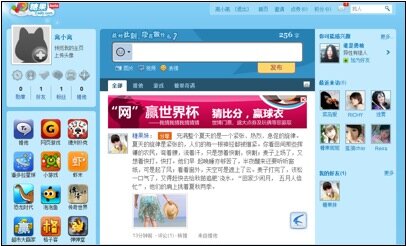
Shanda Launches Candy: A mashup of Twitter, Facebook, and Foursquare


Candy (Tang Guo / 糖果) mixes microblogging, social games, and badges, a mashup of Twitter, Facebook, and FourSquare. While most social networks are scaling back social games to focus on real friends (e.g., Facebook, RenRen, and Kaixin001), Shanda’s Candy embraces games (with a semi-open platform) and nicknames.
It’s almost cliché for Chinese internet giants to launch a microblog or social network; nearly all have tried. The challenge for Candy (in Beta) is to gain initial traction and to achieve user retention. The latter could be challenging for such a casual site, there’s a reason the other social networks are moving away from that model.
Candy reflects Shanda’s effort to diversify into casual games. Over 86% of Shanda’s 768 million USD in 2009 revenues came from Massive Multiplayer Online Role Playing Games (MMORPGs), while casual games accounted for just 12% of revenue. As Shanda’s bread-and-butter MMORPGs like Woool and Mir 2 age, it is imperative that the firm finds new hits or market models.
One analyst recently downgraded Tencent, which derives 48% of its revenue from online gaming, over concerns about a slowing MMORPG market:
We believe social network games are competing against MMO games for users’ time. Chinese Internet users now have more diversified entertainment means than before, causing high-monetization MMO games to lose growth momentum.
The Interface: Sweet Like Candy
As the name implies, Candy is cute and bubbly—perhaps sweeter for girls than guys. The closest analog is Qzone by Tencent, which also mixes nicknames, cuteness, and games, although that site suffers from poor execution.
At the core of the site is a microblog that allows for far richer interaction than Twitter. The character limit is a generous 256 (almost an essay in Chinese), comments are threaded, and pictures, videos and emoticons can be attached.
Users also gain badges for sharing, playing, and friending.
The Games and Applications: The Simpler the Better
Candy offers 33 applications (17 are games), including a few from 3rdparties. Production quality of the applications is high: the graphics are attractive and the functions are simple and intuitive.
All applications are pre-installed with square logos in the style of the iTunes Store. The design team closely followed the hottest in Western tech and design, while still adding elements familiar to Chinese netizens: a cute design, emoticons, and footprints.
New applications include:
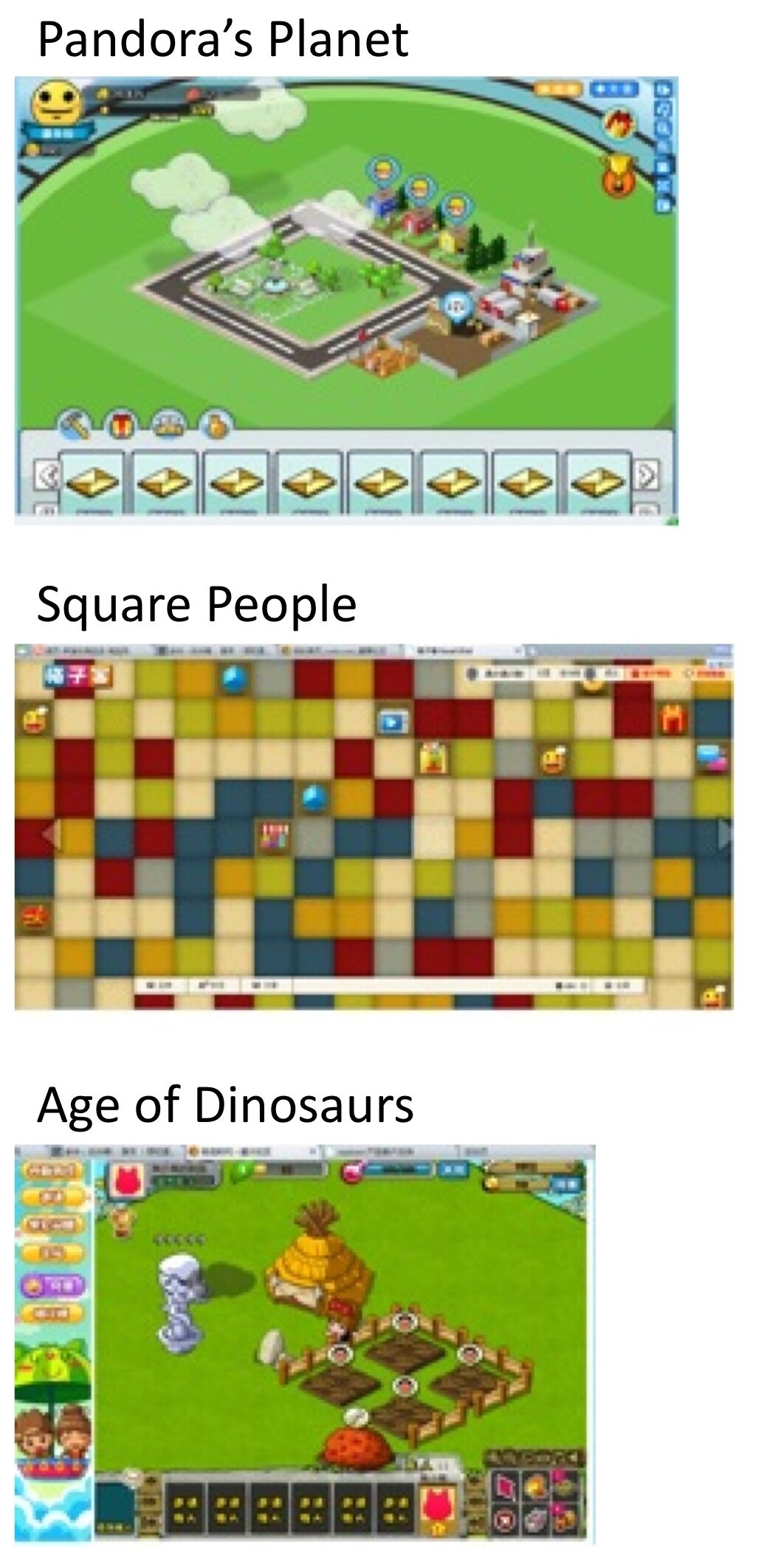
  • Pandora’s Planet (by Shanda): a simplified version of Sim City, in which players strive to expand their city.
  • Square People (格子客, by Shanda): Players flip over a square to discover a surprise task or video behind it (e.g., add person x as a friend).
  • Age of Dinosaurs (by Shanda): A farm game with a dinosaur theme that encourages more interactions between users. Prayer ceremonies can ward off dinosaur attacks.
  • 3rd party applications include a music player (Xiami), video player (Ku6), and the popular social game Bubble Fish (泡泡鱼), which is also found on the RenRen network.
Shanda’s star MMORPG Mir 2 (传奇世界) is also an application (though it’s not yet operational), indicating an attempt to bridge the gap between MMORPG and casual gamers. That’s a big divide to bridge, but success would be sweet—and lucrative—for Shanda.Kai Lukoff is an analyst at BloggerInsight and an editor on China Social Games. Follow Kai on Twitter @klukoff