Showing posts with label model. Show all posts

Mar 19, 2010

The visualization of social networking

This is a short clip that describes the integration processing.
How do you make sense?
So simple, so short, but ...

Feb 5, 2010

win-win situation is not enough: new www model


Today, many people think about win-win situation. However, when I discuss with our friends about "How could we development a small social networks",  I found that wasn't enough.  We must be recognized the role and  impacts of customer/audience and that's growing up. Please, think and care our customers.

Jan 31, 2010

The evolution of Marketing Communication

Created by Hai Le


This is my 3|C model.
Today, marketing 2.0 likes a circle in which it have three components (Corporation, Channels, and Customer).
First, It's not like a separate marketing campaigns. Marketing 2.0 is the continuous processing where marketer must keep track everything on real-time. The marketers have role as a stock brokers. They spent a lot of time for monitor the marketing and they try to understand and forecast the market.
Second, audiences will not passive anymore. Audiences can choose a contents that they need and want. They also is the decision maker that content's good or bad. For example, social bookmarking is the where user evaluation the contents. Hence, marketers can't use push strategy anymore. 
Third, two-way communication is the serious requirement. 
Fourth, the relationship between corporation and customer will be more strength. That's the effect of two-way and real-time communication. 

Jan 28, 2010

Social Technographics: Conversationalists get onto the ladder

by Josh Bernoff
Two and a half years ago, Charlene Li and I introduced Social Technographics, a way to analyze your market's social technology behavior. Social Technographics was carefully constructed, not as a segmentation, but as a profile (that is, the groups overlap). That's because the actual data told me that people participate in multiple behaviors, and not everyone at a higher level on the ladder actually does everything in the lower rungs.
Well, it worked. Despite the rapid pace of technology adoption, the rungs on the ladder have shown steady growth, with some (like Joiners) growing faster than others (like Creators). We have analyzed data for 13 countries, for business buyers, and even for voters. My colleagues and I have done profiles for over a hundred clients, profiling Walmart shoppers, non-profit donors, and doctors.
In all that time, only one thing has been bugging me: there was no place for Twitter.
We fixed that today.
Social Techno Ladder Mark 2

As you can see from the graphic, we added a new rung, "Conversationalists". Conversationalists reflects two changes. First, it includes not just Twitter members, but also people who update social network status to converse (since this activity in Facebook is actually more prevalent than tweeting). And second, we include only people who update at least weekly, since anything less than this isn't much of a conversation.
Conversationalists intrigue me. They're 56% female, more than any other group in the ladder. While they're among the youngest of the groups, 70% are still 30 and up.
The data from this survey continues the trends from the last two years -- Spectators are maxing out at around 70%, Joiners are still growing rapidly, and Creators are still growing slowly.
As in any social environment, people have found lots of uses for this data, some of which make sense to me, and some which don't. Here are three ways you can use it:
1. Convince your boss this stuff is for real, and that if you haven't jumped on it, you're late.
2. Profile your customer base, and see what they're ready for, before planning a project to reach out to them. (After all, People is the first step in the POST process.)
3. Segment your audience; build different strategies for different segments. (Social is so prevalent now that a single approach for your company is probably too broad.)
How will you use it?
Note: For Forrester clients, full access to the research is available here.

Jan 14, 2010

Webinar: Socialgraphics Provides a Customer-Centric Approach to Social Strategy.


Categories: Altimeter, Socialgraphics

Posted on January 11th, 2010

Left: In the past, marketers have relied on tried and true demographics to understand customers. Now, as consumers adopt social technologies, marketers must measure socialgraphics, which indicates how they interact with each other.
Charlene Li and I, Jeremiah Owyang, of The Altimeter Group are hosting a free webinar to understand how companies can understand their customers through socialgraphics.
Beware of plans or proposals that start with “Twitter Strategy” or “Facebook Strategy” Instead, they should have a “Customer Strategy” that focuses in on how customers behave –not on the ever-changing toolset. As a result, companies should first understand how their customers use social technologies before they choose the tools. Socialgraphics is how to measure how customers use social technologies, where they are online, and how it influence them in the context of the customer lifecylce.
This upcoming free webinar, suited for corporations who want to develop plans in social with confidence, will answer how to apply socialgraphics. Like demographics or psychographics, companies must now understand socialgraphics, which answers five key questions:
Socialgraphics answers five key questions:
  1. Where are your customers online? First, find out where your customers are online, knowing which websites they are particiating at, this will reduce guessing.How to make this data actionable: Don’t aimlessly approach social networks without knowing if they are there, if they are in Hyves, Mixii, or Facebook, go there. Fish where the fish are.
  2. What are your customers’ social behaviors online? How do they use social technologies? Do they share? Comment? Create their own content?How to make this data actionable: Which social features should you deploy. Example: if they frequently like to comment on websites, allow them to leave their comments.
  3. What social information or people do your customers rely on? How to make this data actionable: If they rely on their friends, facilitate a marketing program that encourages customers to share with friends, this data helps with determining resource allocation on advocacy programs.
  4. What is your customers’ social influence? Who trusts them?How to make this data actionable: If your customers are trusted by others, highlight your customers in front of their community. For example, teens may share information with each other, spreading their influence to others.  Example: Walmart’s 11 Moms blogger program is a platform for customer voices.
  5. How do customers use social in context of your products? How do customers use social technologies to learn, make decisions, and support your products and services? How to make this data actionable: Be confident in your resource allocation by understanding when customers rely on social tools or their peers in pre-sales, awareness, decision making, implementation, or support of a product.
When properly deployed, Socialgraphics, helps companies, their agency partners, and business units be more effective in their planning and deployment –reducing risk from deploying without having knowledge.
In the spirit of open research, we will make this webinar, the slides, and the overall methodology available for the public to use, under creative commons license. We hope you’ll join us.  Stay tuned as we have other webinars coming soon.

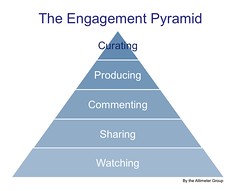
Socialgraphics: The Engagement Pyramid Offers An Understanding of Customer Behaviors
Above: The Engagement Pyramid makes it easy to understand the specific behaviors of socialgraphics, making it simple to decide which technologies to deploy. Having customer understanding makes go-to-market strategy more effective.

Twitter & Maslow’s Hierarchy of Needs … nay … Hierarchy of #Tweets


by Dina Mehta on 01/12/2010 11:23   0 comments , 2448 views 


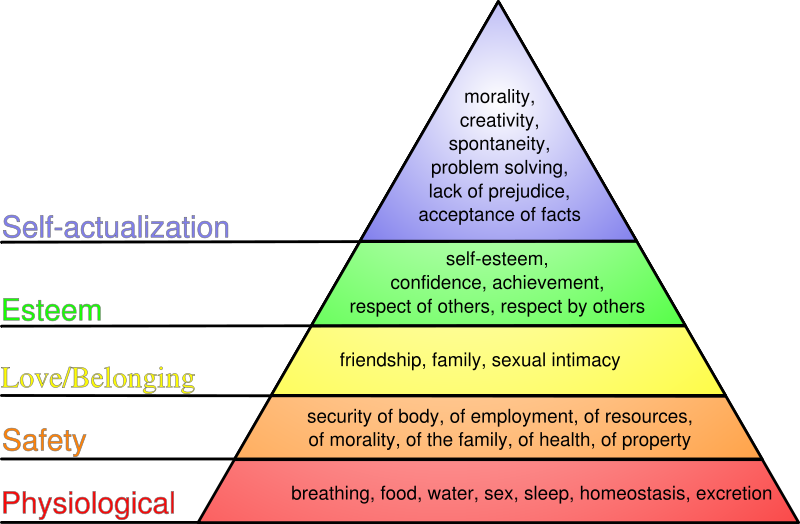
I was chatting with a friend today who’s not a Twitter user, and trying to explain why I like it, and why so many people do too. I found myself turning to Maslow’s Hierarchy of Needs and his Theory of Human Motivations to try and explain this. I discovered this blog post titled The Hierarchy of Tweets at theInnovation Diaries, with this clever diagram based on Maslow’s model. The author makes an interesting connection between what motivates people and how these needs are expressed in 140 characters:
Click to Enlarge
I also discovered this neat little blog post by students of new media at the University of Amsterdam, where the question discussed is whether Twitter is in fact a tool that nourishes our social needs or is it in fact, increasing our needs to keep track of our friends every minute of the day? Here’s a clip:
Humans are social beings with social needs. We need each other to grow as well. Rom Harré describes in his book ‘Social Being’ that we exist as persons for ourselves and other people. We exist solely by the virtue of networks of relations in which we stand to other human beings of our kind. We are partially created by other people and our actions and interactions are jointed actions [3]. Twitter in this case would be a platform on which network of relations are enhanced. Networks are created and the followers you have and you follow are people you have shared interest with; they are ‘humans beings of our kind.’ Aristotle on the other hand speaks of how achieving the good life. We all have social needs and to have a good, successful and happy life we need to socialize with others. And because humans are by nature social beings it is good to live in a society in which the social life is mostly based on a community. Social life in a community is a necessity for a human’s complete flourishing as a human being. Another aspect that Aristotle addresses is friendship. This mutual admiration between two human beings is a necessity. This moral admiration for one and another is essential in friendships and taking advantage of these friendships can make a person fully human. [4]. The Maslow’s hierarchy of needs also addresses this fact. After physical and safety needs we all have our social needs. According to Maslow these social needs involve emotionally based relationships such as friendship and intimacy.
And how can one forget this piece – Understanding the Psychology of Twitter– at Moses Ma’s The Tao of Innovation Blog, written in March 2009.
All this research took me back to 2007, when I had talked about Social Media Strategies – Let’s Remember Maslow’s Hierarchy of Needs. I had then said:
Click to Enlarge - Maslow's Hierarchy of Needs
Web 2.0 companies have shown the way – their products are in perpetual beta, their architecture and marketing is decentralized, they encourage communities of users to self-organize around them. Recently, in an email to Rob, I wrote …. I think one of the most difficult things for people to do is give up control and relinquish ‘power’ to the many unless they see tangible ‘cost-per-click’ sort of gains. It’s the single largest barrier to accepting and adopting a process that is different to one we have been so conditioned to. Sadly, what few realise the act of giving up that power itself can be so empowering for them – why is Wordpress gaining popularity – why is Flickr so popular – why are del.icio.usand Skype and so many others gaining traction today? They weren’t built in a day and pushed onto us as a final product or service – they are being built by and around the community that breathes them. The folks behind them had the guts and vision to say – let’s see how our customers ‘play’ – how they self-organize into networks (developers for instance) – embrace the criticisms with the accolades – and build around what they build. Chaos ….. and creativity. So powerful.
and
I’m not one of those academics who is framework-crazy or model-crazy, still it is good to pause sometimes, and reflect on their relevance and application, especially those that deepen our understanding of basic human motivations , which directly affect how we work, play and even ‘consume’. Triggered by the link I discovered today, I’m amazed at how relevant some of these models are, in our understanding and appreciation of the work we are doing in the social media strategy space. So much of our own social media usage that goes to form what Ton refers to as ourdistributed self, is driven by these needs – del.icio.us, furl, facebook, blogging, flickr, youtube, twitter, plazes, skype, last.fm – the list is never-ending! As I think about each, I see each one fulfilling a different need, and yet coming together to form a lifestream that is driven by the ‘gestalt’, often sub-conscious, of my own needs.
Moreover, the ability for brands and organisations to be in beta, and to listen and engage in Social Media – those that can take that leap, will be fulfilling some of the higher-order needs in the classic pyramid model, and in Jennifer’s circle, forming and providing ecosytems to their customers that enable the fulfillment of these needs. Ultimately, good marketing and PR is always one that delivers on meeting customer needs.
Something marketers, consultants, techies and geeks, and PR folks who are working in the area of Blogger Relations, Social Media and Web 2.0 should well keep in mind when they design their projects, processes, products or services and strategies!

Jan 7, 2010

New Year’s Social Media Resolutions


by 


We’ve  decided to offer a helping hand towards all marketers and brands who have set their minds on social media in 2010. These 5 resolutions are just a start. We’re wondering if you can submit more must have resolutions,  in order to complete the list into a total of 10. So insert your social media resolutions in the comments!

Here are our first 5 resolutions:

1. Make Social Media Marketing Budget Line Item

Most Chief Marketing Officers are massively tapping into social media marketing in 2010. They all want that golden social media marketing strategy for 2010 and beyond. The first tip that we have for them: make sure to create a social media marketing budget line item in your SAP systems asap! Without it, you probably can’t spend budget on Social Media marketing (SMM) and having a SMM strategy or roadmap for 2010 and beyond will not be possible. Beware! Perhaps it’s already to late…

2. Generate ROI Using Social Media

The smart marketers that already comprised their social media marketing budgets for 2010 some months ago: make sure your social agency provides you with compelling and viral content. But most of all: let them deliver you ROI.
It’s nice to receive 1 million views for your viral video, or to gain 100,000 new fans on your Facebook page. But these views and friends are worthless if your agency doesn’t deliver you the most important things within marketing: increase your brand awareness, create leads and drive your sales!

3. Start Listening To The Audience

Before you start developing your golden social media strategy, make sure that you have gained all the right insights from listening to your audience. Make sure you know exactly what the audience’s sentiment is towards your brand, products and services. understand what the share of voice of your brand is and compare you social status with your competitors. Social media is all about people, these people have opinions, which can affect the audience’s perception towards your brand.
So stop doubting whether it’s too soon to start listening to your audience, because they have started discussing your brand within social already years ago!

4. Develop A Social Media Strategy


We already said in 2007, again in 2008 and 2009. Now again in 2010: if you want to play the social game, you got to have a clear strategy!
We all have become very social. Even when we don’t really realize it, brands included. Many brands still try to scream to their audience, but they’re not really sure anymore if they are being heard. Social media is still growing rapidly and your audience have so many options to interact with their network. So how can a brand can become one of them and step into the conversation? We know that online reputation, ratings and reviews are the decision making differentiators in the buying process of digital natives and that advertising comes next. Forrester showed us that 92% of all 16-34 years only buy a product if social influencers , opinion leaders and their peers have written a positive review about it.
So if you want to play a serious role within social media, you’ve got to have a clear, long term strategy. Relationships are being build within long term programs and not within 1 Facebook campaign. It’s just as in real life, strong relationships are not just for Thanksgiving or Valentine’s Day, but for the whole year.

5. Always Remember The 4 C’s

So if you are that smart marketer and you have decided to develop your long term social media strategy, please adopt the 4 C’s of Community within your strategy, as published on Futurelab:
Content
Quality content is a great way to attract people who are needed to form the community that your brand is hoping to build. All community initiatives with relevant topics and content, have to focus on keeping the content itself fresh and relevant, either by your brand or refreshed by its customers.
Context
Context means understanding how and where to meet people, being there where your consumers are up and serving the right experience or content at the right time. Context means investing time in knowing how your users will want to engage with their community – and then enabling them to do so.
Connectivity
Communities thrive on emotional or sentimental, hard to measure activities that are relationship based. It’s not about mass communications but more about micro-interactions. Communities can in theory be the new CRM (Customer Relationship Management) tool for brands, but require people to maintain good relations. This should tell you that if you’ve invested in building a community framework, you need to play host if you’re lucky enough for guests to arrive.
Continuity
Communities which thrive often evolve over time to meet the evolving needs of users. Therefore you need to include functionalities such as blogs, forums and a navigation design which tags topics and references relevant products, a place where you can share ideas, vote for the best idea etc. Communities need to be flexible to evolve over time while still providing a valuable and consistent user experience which can be sustained over time.
So these are 5 resolutions we feel every marketer should engage in 2010. We’re looking forward to your inpu in order to complete the list into a total of 10!

Jan 5, 2010

The 2010 Social Media Marketing Ecosystem


by davefleet on 01/04/2010 07:24   0 comments , 4074 views 


Forrester Research analyst Sean Corcoran recently posted a insightful breakdown of some of the differences between owned media, paid media and earned media. Given the ongoing convergence I’m seeing between different communications disciplines which I’m seeing on a daily basis, this got me thinking.
Owned, paid and earned media breakdown
The thought process ultimately led me to sketch out my take on the social media marketing ecosystem in which corporations operate – shown below.
This is my take on the ecosystem within which the new wave of hybrid marketing agencies like ours need to operate as we enter 2010.
Social Media Marketing Ecosystem
Social Media Marketing Ecosystem Legend
This is pretty complex, so I’ve broken it down into different system elements below. Note though, that the different elements work best when we succeed inbreaking out of communications silos and integrating our communications strategies.

A few notes up-front

  • As complex as this image is, it’s still a drastic over-simplification. There are many more linkages than are displayed; I’ve simplified to the graphic is still readable.
  • The ecosystem is constantly changing. A few months down the line, the big four social networks may have changed.
  • There are many, many other social networks, forums and other sites not directly shown here. They’re grouped into “Other” but may in fact play a significant role in your activities, depending on your company.
  • MSM stands for “mainstream media.”
  • Each of the different elements can both act as a focal point and/or support other tactics, depending on how they are used within an integrated strategy.
  • The following sections each filter certain elements from the overall ecosystem above, to provide a simpler view of the owned, paid and earned elements of the system.

Corporate Social Media Ecosystem (Owned Media)

Corporate Social Media Ecosystem
Key elements of the ideal corporate social media ecosystem:
  • Hub and spoke: Adopts a ‘hub and spoke’ system centred around a corporate social media hub, whose form will depend on the organization.
  • Tiered hub and spoke: Each social network may have its own hub and spoke system, if necessary. For example, you may have a primary corporate page on Facebook supported by several applications and product-specific pages.
  • Integrated: The hub is as integrated into the corporate website as possible.
  • Fewer Microsites: Todd Defren and Maggie Fox both make compelling cases for companies to stop and think before investing in microsites. I agree. They may have their place in this ecosystem, but shifting to a social network or building on top of your flexible social media hub may make more sense.
  • Mobile is ubiquitous: I considered including mobile as a separate component in the ecosystem, but decided against it. The web is becoming device-agnostic. Companies need to consider mobile content and applications as part of every aspect of their corporate web presence.
  • Inter-linking: The social media hub links to all external corporate social media properties and profiles.
  • SEO-powered: Search engine optimization (driven, in part, by social media activities) helps to drive traffic to the corporate website, social media hub and external social media properties and profiles. This goes for both the corporate site and separate properties. SEO could fall into any of these buckets, but for the sake of simplicity I’ve included it in this part of the breakdown.
  • Two-way flow: The information flow around social media elements is (depending on the organizational context, of course) two way.

Corporate Mainstream Media Ecosystem (Earned Media)

Mainstream Media Ecosystem
Key elements of the mainstream media portion of the ecosystem:
  • On and offline: Mainstream media exist both online and offline (many are both). Either way, they can drive significant traffic within the social media marketing ecosystem.
  • Two-way: Ideally, the information flow with mainstream media is two-way in two ways:
    • Earned media drives quality traffic to your properties; your properties can generate stories within the mainstream media (both positive and negative)
    • One of your goals should be a constructive dialogue with mainstream media which enables you to achieve your goals while making the journalists’ lives easier.
  • Multi-destination: Earned media coverage will primarily drive traffic to your corporate site in the short term. However, earned media coverage can raise broader awareness, thus driving traffic to your external properties and social media profiles (especially over time within a sustained media relations program).

Corporate Advertising Ecosystem (Paid Media)

Corporate Advertising System
Features of the corporate advertising ecosystem:
  • Social and non-social: Advertising takes place both within social media sites, but also within other online properties (search engines are a prominent example, as is CPM/CPC advertising on mainstream sites).
  • Interwoven: While paid online media stands alone within the social media marketing ecosystem (represented here by “SEM,” it is also interwoven throughout many other elements.
  • Multi-destination: Much of your advertising may drive traffic to your corporate website. However, advertising can also support your social media efforts by raising awareness and driving people to your social media profiles and properties.
  • Multi-faceted: “Ads” within many social networks can mean many things. Facebook, for example, your advertising activities might extend beyond regular Facebook ads and into “appvertisements.”

Make sense?

Together these different elements combine to form the more complex (yet still simplified) ecosystem displayed at the top of this post.
This is clearly far from complete. I’m curious as to your thoughts – let me know what you think in the comments and let’s refine this together.