Showing posts with label management. Show all posts

Mar 28, 2010

When Conversion Rate Isn't Enough

Posted by Dr. Pete on March 24th, 2010 at 7:28 pm Analytics


The history of web analytics has read a bit like the quest for the Holy Grail. We've gone through a list of candidates searching for the one true metric: Hits, Page Views, Visitors, Unique Visitors... stopping at each one to admire its purity and virtue while denouncing the heresy of whatever metric it replaced (usually, one whose purity and virtue we were just praising the week before).

While drinking from the wrong Grail in analytics won't melt your face like the bad guy in Indiana Jones 3, you may wish for some face-melting when you have to tell your boss how much money your bad conclusions just cost the company. This post will help you get control of your unhealthy obsession with Conversion Rate and avoid the most costly traps.

Conversion Rate Crash Course

Let's start with some basics, both for the newcomers and because the industry doesn't always agree on how to define terms:
conversion rate definition
There are many variations on conversion rate, and "Action" can mean just about anything – a click, a form submission, an RSS subscription, an actual sale – but let's keep it simple for now. So, let's say that for February your site received 10,000 visitors, and 450 of them took action:
conversion rate scenarious
Pretty simple, right? Don't get me wrong – conversion rate is powerful, and it captures an important bottom-line measurement. Problem is, it's just one number (well, ultimately, two numbers). So, what's missing? To answer that question, I'd like you to consider three scenarios...

Scenario 1 – Sacrificing Traffic

This is a situation that comes up frequently in PPC management – cutting traffic to raise your conversion rate. Here are a few examples to illustrate the point:
All three of these cases have 5% CR, so they're all the same, right? Of course not - all else being equal, anyone in their right mind would pick (C). Where people get into trouble is when they over-optimize for CR at the expense of traffic.
For example, let's say you have a classic PPC scenario: (A) a campaign targeting branded keywords with low traffic and high CR, and (B) a campaign targeting product keywords with high traffic and low CR. Your client starts complaining about low CR, so what do you do? You cut spending in Campaign (B). CR goes up, but the unfortunate side effect is that traffic goes down and overall Actions (read that "sales") go down with it.
SOLUTION:
Pay attention to both conversion rate and overall leads or visitors. Once you collapse down to CR, you've lost the top and bottom numbers and are left with just a ratio. If you're a PPC manager, set an acceptable Cost-Per-Action (CPA). Traffic within your CPA limit may be worth going after, even if CR isn't ideal – traffic that costs more than your acceptable CPA may have to be sacrificed. Don't just start chopping visitors to see CR go up.

Scenario 2 – Dropping Prices

Want the secret to increasing conversion? Cut your prices in half. What's that? You say you'll make a lot less money that way? Yes, you probably will. Of course, you'd never do anything that radical, but many people create sales, price pressures, and information architectures that drive people to the cheapest product. This can boost CR but cost you money.
Let's look at an example – say you get 1,000 visitors per day, and experiment with pushing a cheaper product ($29) over a more expensive product ($99) to boost CR:
Looking at the CR, it's great news: you doubled conversion. Unfortunately, your revenue also dropped 40%. There may be times when you're willing to make this trade-off to draw in new customers, but make sure you have all of the information you need to make that business decision.
SOLUTION:
If you make a change that could drive visitors to lower-priced items, make sure you track not only CR but also changes in the average purchase amount. If you're running an A/B testing scenario, consider tracking the mean or median purchase for both groups (use the median if your products span a wide price-range).

Scenario 3 – Losing Loyalty

An aggressive push to drive short-term conversion, including the pricing scenario above, could also lead to a drop in long-term revenue and customer loyalty.  If you offer a sweetheart deal that pulls in new customers, it's possible that they'll take advantage of that deal and disappear forever. Today's Conversion Rate gain, if it's driven by bargain hunters or impulse buyers, could be next month's Conversion disaster.
That's not to say that sales and short-term incentives are never a good idea. Driving traffic in the front door is essential to building long-term relationships. The core point is that, whenever you take an action that may change the quality of your customers (and not just the quantity), you need to look at the big picture.
SOLUTION:
These metrics are a bit beyond the scope of this post, but there are a number of Key Performance Indicators built around repeat buying and the lifetime value of a customer.  Whenever you pursue a short-term strategy, don't just measure CR, measure whether those new buyers are one-hit wonders or have real staying power.

It's Still Pretty Good

I don't want to sound like I'm bashing Conversion Rate. I use it every day and have driven real, bottom-line improvements for clients based on CR metrics. We just have to remember to never get so enamored with one metric that we neglect the big picture. Every web metric that has ever existed or ever will exist is missing some critical piece of information for some set of situations and has the potential to lead us astray. Think about your objectives, think about the possible outcomes, and most of all, think about all of the analytics tools you need to see that big picture.

Mar 23, 2010

Five Reasons Why Companies Should Not Block Employee Access to Social Networks

Last week, a client told me that they don't allow employees to access YouTube at work. "Do your employees carry cellphones?" I asked. The answer was "yes," of course. Well then, most of them already have access to YouTube - right in their pockets.
The fact is, resistance to social network access at work is futile.
socnet.pngThe Economist, in a special report on social networking, notes that a survey of 1,400 chief information officers conducted last year by the recruitment firm, Robert Half Technology, found that only one-tenth of them gave employees full access to such networks during the day, and that many were blocking Facebook and Twitter altogether.
Five reasons companies should allow social networking
1- Resistance is futile.
Workers increasingly have Internet access on their smart phones. By the year 2013, 43% of global mobile internet users (607.5 million people worldwide) will be accessing social networks from their mobile devices, according to a new report from eMarketer
2- Don't assume people won't find other ways to waste time.
Executives' biggest concern? That social networking would lead to "Notworking" instead of doing their jobs. As the Economist report notes "This assumes that people would actually work rather than find some other way to pass the time they have to spare."
3- Social networks actually can make workers more productive.
Three out of four of the 895 experts interviewed for the recent Pew Internet report The Future of the Internet IV, said that use of the Internet enhances and augments human intelligence, and two-thirds said use of the Internet has improved reading, writing, and rendering of knowledge," according to Janna Anderson, study co-author.
4- You'll miss great ideas.
Great ideas can come from any level of a company. Using social networks internally (wikis, blogs, forums, even IM) fosters collaboration, and allows workers at all levels to contribute ideas.
Experts emerge from within a company when collaboration is encouraged, and along with them come some of the best ideas that would otherwise be lost. Because people can comment on information, companies often learn of internal expertise they didn't know about already.
In most big companies, instead of collaborating, marketing competes with sales, advertising competes with PR and so on, creating silos that prevent fresh ideas from being heard.
I've consulted to companies where the marketing directs of divisions had never even met their counterparts in other divisions, let alone collaborated with them. As a result, they often were working on similar projects without sharing knowledge or resources. This wastes money, and squanders ideas that could be helpful company-wide.
5- Employees are much more trustworthy than companies think.
Managers worry that employees will leak confidential information, or speak poorly of the company.

Most people have much more common sense than to jeopardize their jobs, with wanton comments in social networks, especially these days.
If you can't trust your employees, you have one of two problems: you are hiring the wrong people or you are not properly training the people you hire.
People who want to say something negative will find a way, with or without access to social networks during business hours. However, negative feedback also can provide an early warning that changes need to be made, either in policy or employees.
Publish Post

All in all, companies have more to gain than to lose by allowing employee access to social networks. My bet is that it'll take another two years for most companies to figure that out.

Jan 14, 2010

A Framework for Social Media in Crisis Management

 by John Bell on 01/13/2010 00:43   0 comments , 1410 views 
This presentation which I and Jamie Moeller delivered recently through our partnership with the Wall Street Journal (and thanks to Thomas Crampton), offers a solid framework for Digital Crisis Management using social media (and responding to social media).
In it you will find:
  • 5 Trends In Digital Crisis Management
  • A Digital Crisis Management Framework
  • 5 Keys to Managing the Crisis

Dec 20, 2009

5 Near Free Social Media Monitoring Tools

14 Comments and 0 Reactions | Posted by Michelle Bowles on Dec 18th, 2009 in Online Marketing,Social MediaWeb Analytics


The good news: 86% of professionals have adopted social media in some way, according to a recent survey by Mzinga and Babson Executive Education.When it comes to businesses leveraging the social web to communicate with customers and improve brand awareness, there’s some good news and there’s some bad news.
The bad news: A whopping 84% of survey respondents who’ve adopted social media don’t measure their social media programs.
Even worse: 40% weren’t even sure they could monitor social media ROI.
Thankfully, there are a host of free or low cost tools available to help companies and organizations track social media success. Use one or more of these 5 social media monitoring tools to gauge how well your efforts are working.
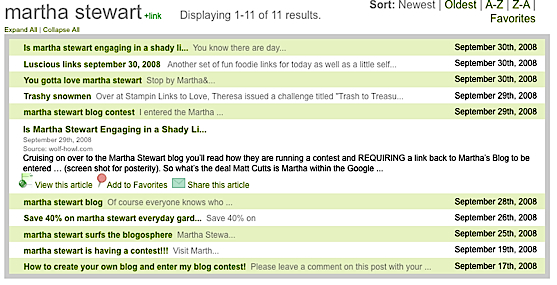
1. Trackur
This social media monitoring tool from ORM expert Andy Beal tracks nearly every element of online media, from blogs, RSS feeds and Tweets, to images and video. Trackur provides the ability to not only view conversations about a brand, but also view the increasing or decreasing volume of the conversation. That way, users can be alerted to any spikes in buzz from a product launch or a negative event. Plus, Trackur offers analysis of any website mentioning a term being monitored, allowing users to distinguish how influential that site is. Monthly subscriptions to Trackur start at $18 per month.
Trackur
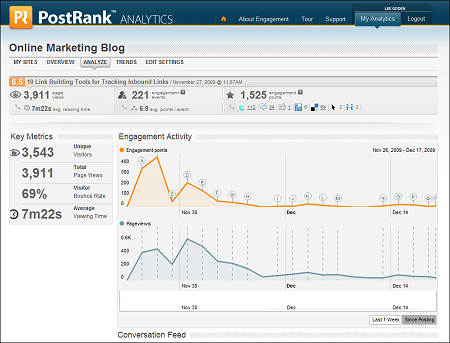
PostRank provides engagement scores to gauge how well pieces of content (i.e., a blog post, a news article) convinced users to take action (i.e., re-Tweet, a blog post comment, an RSS view). But beyond that, this social media monitoring tool shows the messages and comments from other sites that are contributing to the engagement score. In addition to individual pieces of content, this free service also maps out engagement activity and number of page views for entire blogs or websites per day.   PostRank also offers integration with Google Analytics.  Cost is $9 per month to track 5 sites. The image below illustrates a single post analysis with both engagement metrics and pageviews.
postrank-analytics
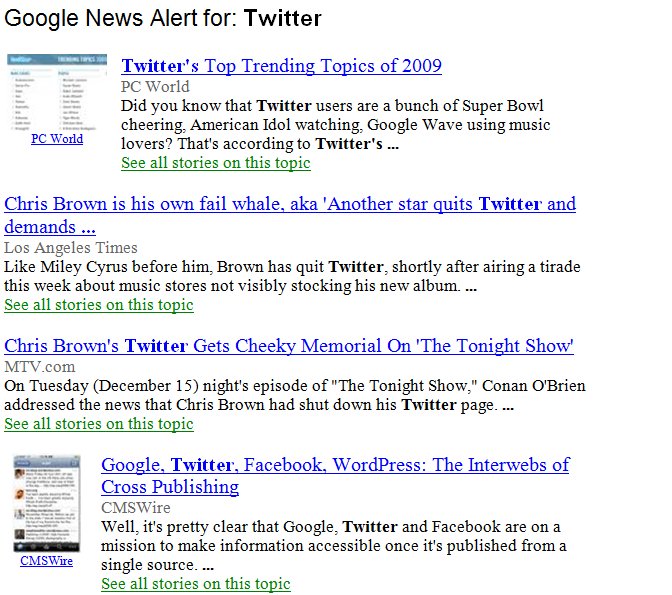
This free tool from Google provides email updates of the latest relevant Google search results. It’s as simple as choosing a search term, determining the type of search results to be tracked (news, blogs, web, video, etc.), selecting update frequency and entering an email address. Google Alerts is one of the easiest ways to monitor brand mentions for both company and product names. Plus, the tool can be leveraged to monitor competitor mentions.
Google Alerts
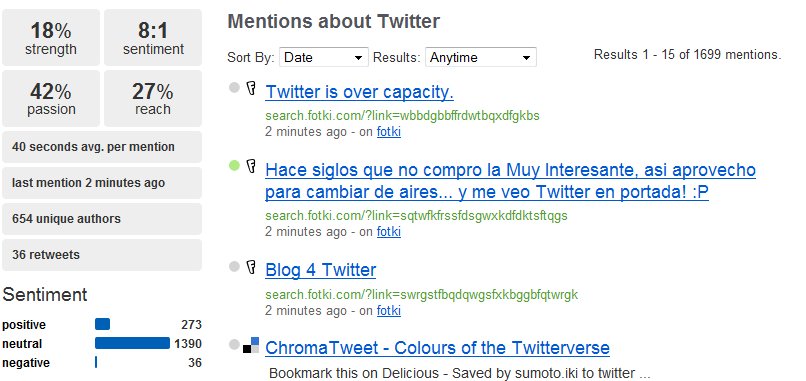
Similar to Google Alerts, Social Mention – a real-time search engine – aggregates search results from blogs, microblogs, videos, bookmarks and other social sites. But this free monitoring tool goes a step beyond that. Social Mention provides a social ranking score based on popularity for every search (i.e., how often the search term is mentioned, if the sentiment is positive/neutral/negative). All of this data can even be compiled into a CVS or Excel spreadsheet.
Social Mention
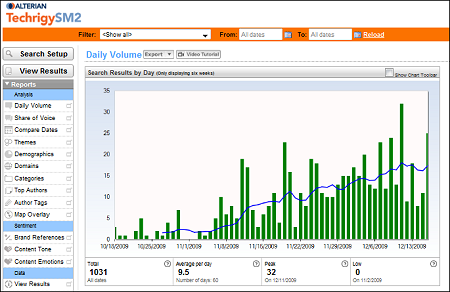
SM2 is a software solution designed specifically for PR and Marketing Agencies to monitor and measure social media. The “freemium” version of this full featured social media monitoring service allows you to create up to 5 profiles and each query is limited to storing up to 1,000 search results. There are many features with setup and reports as you can see in the screen shot below. Along with standard help and FAQ resources, there’s a Ning powered Techrigy social network or Community of users that you can tap into and share information.
techrigysm2
Incidentally, we did an interview with Connie Bensen, Director of Social Media and Community Strategy at Alterian, the company that owns TechrigySM2 earlier this month.

Whether you leverage one of these low cost or free tools to get started or other tools like Collective Intellect, Cymphony, Converseon, ScoutLabs or Radian6, it’s critical to track social media efforts and tie results back to the goals of your business. Because the scary truth is this: When cut-backs rear their ugly heads, the first programs to go are those that can’t illustrate measurable results and link them back to organizational goals. Don’t find yourself in that 84% of Mzinga and Babson Executive Education survey respondents who don’t measure the effect of social media.

The 4 Cornerstones of Social Media Monitoring


Brian Chappell | December 01, 2009 | 14 Comments

Social media monitoring often gets lumped into very traditional departments inside organizations, and when this happens, certain aspects of the practice can be overlooked. There are many features of social media monitoring beyond its ability to help manage your brand’s reputation via customer service. When brands come to Ignite asking for help with 'social media monitoring', we think holistically with the understanding that the practice helps service many different channels inside of their brand (not just customer service).
The four cornerstones of social media monitoring are (1) Competitive Analysis, (2) Product Development, (3) Reputation Management and (4) Outreach.

Competitive Analysis

Social monitoring can be an extremely effective way to keep tabs on your competitors. In fact, depending how thorough of a job you do, you can effectively use social media monitoring to legally spy on your competitors. The kind of information that can be unveiled can be worth its weight in gold. So long are the days of wondering exactly what your big brand competitors are doing. The only social efforts that are even remotely hidden are some interactions on Facebook. Other than that, most things are free game, and can be effectively monitored. It is not difficult to unearth specific strategies and tactics your competitors might be launching in the social sphere.
Another area regarding competitive analysis that should be thought through is the metrics obtained from your competitors’ overall brand health. Now that you are able to identify specific campaigns they are running, you should be able to assess the overall reaction of a campaign via sentiment analysis comparisons.

Product Development

In the past when a company needed to conceive new ideas for products they would research what their target market wanted via focus groups and other outside research agencies who would mine traditional media clippings. Granted those are still effective practices; however, now that users share anything and everything online, companies have the ability to tap into a vast wealth of knowledge from their customers. There is huge potential for brands to effectively use social media monitoring to help supplement the product development process.

Reputation Management

When fellow social media practitioners discuss social media monitoring it is generally in regards to customer service and reputation management. When companies setup a process for monitoring it generally involves an employee(s) reading posts/tweets/videos/images and deciding whether or not they deserve a response. When companies make the decision to spend budget on a social monitoring plan this is typically what it gets ticketed as, a means to monitor and react to customers.
Unfortunately, as I have noted, there is much more to monitoring a brand and reacting to customers than the customer service angle. Simply sticking the oversight of your monitoring plan with the brand manager or lead customer service representative typically means many of the additional benefits of social media monitoring get kicked under the rug. If you must go this route make sure those in charge of the plan are educated on the real ramifications and make sure they have the means to share information with other channels quickly and efficiently.

Outreach

The benefits of running targeted blogger outreach campaigns via social media monitoring insights can be quite significant. If you are skeptical, listen up. Monitoring really is a means for discovering your passionate customers. Utilizing those fans and turning them into fanatics can have a huge impact. What you do with those individuals discussing your brand is up to you; however, here are a few things you can do to help market your products:
  • Send a blogger who mentioned your product free product
  • Bloggers who discuss your brand consistently can be asked to join a bloggers club
  • Customers who mentioned your site without directly linking to it can be asked to link to the site with custom anchor text
  • Etc.

Summary

As you can see, a holistic monitoring process really crosses over many different segments of a business. Simply sticking monitoring in the customer service department and calling it a day is a huge mistake. Work towards developing the structure and efficiency that is required to effectively orchestrate a well oiled social media monitoring process inside of your organization.