Feb 26, 2010

How To: Use Social Media For Internal Communications

By thomascrampton  February 25, 2010  Post a comment


Watson Wyatt, a human resources consultancy, does a large-scale annual survey looking at return on investment for communication strategies.
One section of this year’s report focused on Social Media as used by 328 organizations that collectively represent 5 million employees in various regions around the world. (Full demographics of those surveyed at the bottom)
First a summary chart of how Watson Wyatt concludes Social Media is best used in a company’s internal communications mix:

Watson Wyatt’s findings:
Highly effective communicators are making greater use of social media than their less- effective peers.
On average, however, usage is fast outpacing effectiveness. While the use of social media has expanded over the last 12 months for all, highly effective communicators are more than twice as likely as the least-effec- tive group of companies to have expanded their use of social media (Figure 14).

The most prevalent reasons for not increasing the use of social media stem from a lack of resources and knowledge, rather than legal restrictions (Figure 15).

Companies that are using social media to engage employees are using these tools to address a variety of topics (Figure 16). The most prevalent topics are collaboration and team building, adapting to change, and promoting health and wellness. The difference between high-and low-effectiveness communicators was not significant in this area. It ranged from a 17 percent difference in providing a line of sight to the business to a 9 percent difference in promoting risk taking; however, less than half of participants are using social media to reach their workforce.
Highly effective communicators are using social media tools 2-3 times more than the low-effectiveness group of companies to reach employees (Figure 17). Most participants (65 percent) expect to use social media more next year.
To get a better return on their investments in social media, however, companies will need to build on their knowledge base and undertake these basic steps:
- Document their social media policy
- Develop tools to measure the success of social media at their company
- Build executive support

Companies are making greater use of electronic and face- to-face communication than before, while the use of print continues to decline (Figure 18).

Demographics of those surveyed:

Profiling Social Gamers

FEBRUARY 26, 2010

Females, older users dominate play


If you aren’t one of the 24% of US and UK Internet users playing social games at least weekly, you may have seen the traces of those players and their FarmVille or Scrabble exploits in your Facebook newsfeed. PopCap Games, maker of several popular titles, explored the demographics of the group in its “2010 Social Gaming Research” report.
More than one-half of players are female, and the average US player is 48 years old. Relatively few US weekly gamers are under 30, while nearly one-half are over 50.

UK and US Social Game Players, by Age, January 2010 (% of respondents)

Most players are not college graduates, and, in the US, just over one-half report a household income under $50,000. Two-thirds of US social gamers also play other video games, but the bulk of their gaming time is with social rather than casual or “hardcore” options.
More than one-third of weekly social gamers play the games several times a day, with a further 30% playing daily. The time adds up: A plurality of sessions last 30 to 60 minutes, leading nearly four gamers in 10 to participate in social gaming for 1 to 5 hours weekly.
Facebook overwhelmingly dominated as the top social gaming destination, with 83% of weekly gamers playing on the site. Just under one-quarter used MySpace. Many considered game play their main reason to use such sites, and PopCap reported that about one-half of the time players log in to social sites is to play.

Percent of Time UK and US Social Game Players Log in to a Site Specifically to Play, January 2010 (% of respondents)

Social gamers are mostly interested in connecting with friends and exercising their competitive instincts, but the activity makes them a prime target of social network marketing, including virtual currency, virtual gifts and ads.
Slightly under one-third told PopCap they had spent real-world money on either virtual currency or a virtual gift before. And one-quarter claimed they had been “misled” at some point by an ad or special offer related to a social networking game.
Q Interactive study of female social gamers found that nearly three-quarters would not pay to play, but most felt happy about receiving virtual gifts. About one-half noticed brand presences in their virtual games, such as through sweepstakes, offers and surveys.
Keep up on the latest digital trends. Learn more about an eMarketerTotal Access subscription today.
Check out today’s other article, “A Shot of Mobile Apps.”   

Feb 24, 2010

Facebook Dominates Social Content-Sharing


FEBRUARY 23, 2010 


Widgets widely used to share entertaining content


While Q3 2009 data showed e-mail on top for content-sharing, February 2010 information from social optimization platform Gigya points to Facebook as the Web’s top social sharing hub.
Almost one-half of article links, videos, photos and other content shared via Gigya’s widgets are posted to Facebook, with another 29% broadcast through tweets.

Social Media Sites Used by US Internet Users to Share Online Content* via the Gigya Widget, February 2010 (% of total)

Social sharing widget AddThis also distributed the most content on Facebook (33%), followed by a long tail of other options. Similar results were posted in summer 2009 by the AddToAny sharing widget; Facebook, with 24% of shares, took the top spot.
In addition to sharing content with contacts, social site logins are often chosen as a method of user authentication on third-party sites. Facebook was No. 1 for this purpose as well, but usage was dependent on content type, indicating that Facebook users may be most concerned with sharing fun, entertaining content on the network.

Share of User Authentication* Services Chosen by US Internet Users, by Site Category, February 2010 (% of total)

The social giant’s 52% share of authentications on entertainment sites dropped to just 31% on news sites, where Google made a close second place showing with 30% of logins. Yahoo! also boosted its share to one-quarter of news site authentications.
Keep up on the latest digital trends. Learn more about an eMarketerTotal Access subscription today.
Check out today’s other article, “How Retailers Can Reach Moms.” 

13 Ways to Move Your Facebook Fans to Action

By Mari Smith
Published February 23, 2010


Perhaps you have a Facebook Fan Page and even some fans.  But now what?  How can you encourage your fans to act and interact?
In my prior post I covered the various sources and types of content you can post on your Facebook fan page. I also talked about the importance of consistent updates.
However, just like the “Field of Dreams” – if you build a fantastic fan page with plenty of quality content, will they come and will they stay?
They will come and they will stay if you give your fans good reason to engage.
Facebook fan page engagementGiven that over half of Facebook’s 400 million active users log in daily and spend an average of 55 minutes per day on the site, you can get your target audience to spend some of that time getting to know you, your brand, your products and services.
The secret is to create a fan page with the right blend of ingredients that resonates most with your ideal fans. And to ensure they’re made to feel a strong part of your online community.
As mentioned in Part 1, I’ve found there are essentially two components to Facebook fan page engagement: 1) Sharing quality, relevant content and 2) inciting comments. So, here in Part 2, we’ll talk about just how vital comments (and likes, wall posts and @ tags) are to the success of your fan page.
Now that you have a wide variety of regular, quality, relevant content posting on your fan page, here are some ways to get your fans to interact:

1. Ask questions

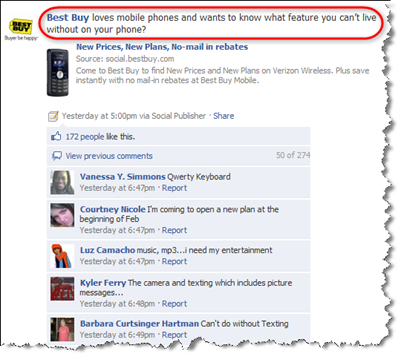
For status updates, try ending with a question. In the example below, Best Buygenerated 274 responses so far to their question about what feature your can’t live without on your phone.
Best Buy on Facebook
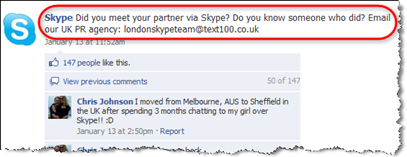
And, in this example, Skype got 147 comments to their question about meeting your partner via Skype!
Skype on Facebook

2. Use the words “you” or “your”

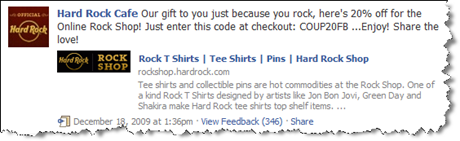
Use the word “you” often – “What are your thoughts?” “What do you think about xyz?” Here, the Hard Rock Cafe is giving out a coupon code with the words “Our gift to you because you rock…”
Hard Rock Cafe on Facebook

3. Keep it short

The easier it is for your fans to read, the more likely they are to respond. Keep your status updates short and simple with one topic. You have up to 420 characters per update, but I recommend about half that for an ideal size. For longer updates, use the Notes app – or write a blog post and update.

4. Post in high-traffic windows

Get to know when your fans are most responsive. Depending on in which part of the world the majority of your fans are, you might want to post between 9:00am and 2:00pm in your timezone.

5. Respond promptly

Do your best to respond to fan questions (as wall posts) as promptly as possible. If you find you can’t keep up with the volume of questions, offer a free teleseminar or webinar where you answer the top questions for your fans. You can do this in the traditional way of having people opt-in to get the phone number so you’ll build your email list at the same time.

6. Address fans by name

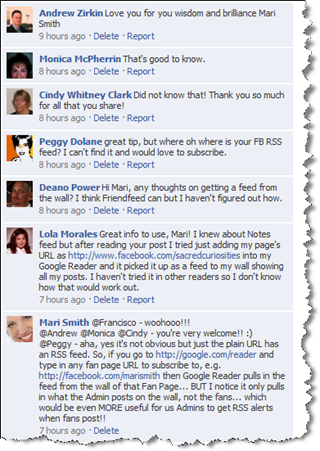
Come back and reply often to your fans’ comments – Facebook currently doesn’t have threaded commenting, so I suggest addressing specific fans in your comments as @name. See my comment at the bottom of the screenshot below:
Facebook comments

7. Comment yourself

Add your own comment as needed to get the ball rolling. However, don’t step in too soon. I often find that the comments come more freely when you allow your fans to run by themselves initially.

8. Thank your fans

Acknowledge your fans often with simple thanks. Genuine recognition goes a *long* way!

9. Surprise your fans

Don’t be afraid to stray “off topic” from time to time and surprise your fans. In other words, your content doesn’t always have to be directly related to your product or service. You might share an inspirational quote and add your own thoughts, for example.
Facebook quote
If you happen to know a fan’s Twitter ID, send a tweet thanking her/him for the comment on your fan page. With a link of course. :)

10. Use @ tagging

You can tag other fan pages that you’re a fan of and your own friends (along with Groups you belong to and Events you’ve RSVPed for). When appropriate, and used sparingly, @ tags can be a very powerful way to have your post show up on others’ walls, which gives you more exposure and brings more fans or potential fans back to engage.

11. Use the Discussion Board

Give your fans a place to network with one another. Plus, often fans want to do self-promotion. You can encourage these types of activities on a specific discussion thread. Also, when you first launch your fan page, be sure to start 3 to 5 discussion topics so it’s not a blank  tab.
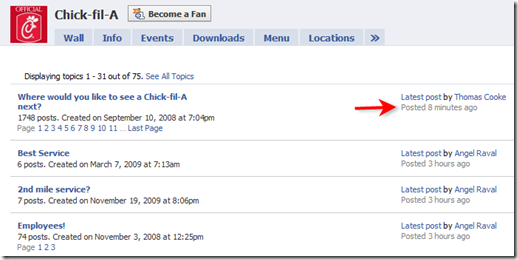
In this example, the most popular discussion thread on Chick-fil-A’s fan page is asking their fans where they’d most like to see a Chick-fil-A next. Topics are always listed in order of the most recently commented on.
Chick-fil-A on Facebook

12. Send updates to fans

Each tab on your fan page and each discussion thread topic has its own unique URL. To bring fans back to your page to contribute to a discussion and get them more engaged, send out an update with a call to action and specific link. (To find the Update feature, click Edit Page under your image then look for Send Update to Fans on the right of your Admin page.)

13. Monitor insights

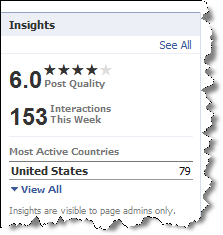
If you’re a perfectionist, the goal is to get 5 stars and a perfect 10 score! Facebook uses algorithms to calculate your Post Quality as determined by the percentage of your fans who engage when you post content, calculated on a rolling seven-day basis. The number of stars depends on how your Post Quality compares to similar pages (for example, pages that have a similar number of fans).
Facebook Insights
The more activity your fan page posts generate, the longer you’ll show up in the News Feed of your fans!
As you build up your fan base, consistently add quality, relevant content and engage your fans. You’ll start to see results that translate into an increase in brand awareness and positive brand sentiment, email and blog subscribers, and of course, sales and paying customers.
How are you engaging your fans? What did I miss? I’d love to hear from you. Add your ideas in the comments below. And do ask any clarifying questions as I’d be happy to answer you.

Feb 14, 2010

SocialTALK Helps Businesses Diffuse Social Media Clutter


Although many businesses are starting to embrace social services and networks to connect with potential customers, such tools are still by and large built for end users, not for businesses. That can make managing multiple social media accounts, moderating comments and scheduling posts difficult.
Syncapse launched its SocialTALK social media workflow tool this week, which is designed to help companies control their presence on different platforms, as well as monitor feedback.
Social management tools are slowly starting to become more relevant. ContexOptionalVitrue SRM and Salesforce.com are all targeting this space in various ways. SocialTALK’s approach to it is to plug into various platforms that can all be managed from one dashboard.
Check out this video:

Right now SocialTALK supports TwitterFacebookWordPress and MoveableType. You can create new posts, moderate comments, schedule when posts go out and push the same content across to multiple networks at once.
The organizational features are great, but the features that have the most potential are the real-time analytics. We’ve discussed measuring social media ROI before and as we said then, finding trends and tracking them back to their point of origin is the key to measuring ROI.
While analytics aren’t going to do that for you, if you can get a real-time measurement of traffic, discussion points and comments as they relate to various social media campaigns — and if you can add in identifiers to track that data to either a transaction or other measurable goal — taking control of social media ROI becomes much less difficult.
How does your business manage its social network presence? Let us know!

Twitter Users React to Google Buzz [STATS]


GMAIL USERS: We hope you’ll join the discussion over on Mashable’s Google Buzz account.
Some think Google BuzzGoogle Buzz could be the next huge social platform. Others think it’s one big privacy nightmare. With its launch week drawing to an end, we pinged our friends at Crimson Hexagon for analysis of TwitterTwitter user’s opinions.

The results, not surprisingly, are incredibly mixed. 16 percent of the tweets analyzed were characterized as positive, while 14 percent simply express curiosity. The much talked about privacy issues that GoogleGoogle has already moved to address garnered 15 percent of the tweet activity, though a full 50 percent either don’t like Buzz or are already claiming to be done with it. Somewhat surprisingly, 6 percent expressed loyalty to Twitter in their comments – a sign that some view Buzz as a competitive threat.
The overall buzz, one way or another, has been plentiful. According to another analytics firm – Trendrr – Buzz garnered more tweet volume than Google’s Nexus One launch, with a peak of nearly a quarter of a million tweets on Tuesday.

Feb 12, 2010

Moms Place Trust in Other Consumers

FEBRUARY 10, 2010

Influencing one another


Consumer reviews are significantly more trusted than descriptions that come from manufacturers, according to a survey of US mom Internet users by online video review site EXPO.
Online moms doing product research put their faith in descriptions from consumers nearly 12 times more.

Traditional channels such as in-store promotions and newspaper inserts still have significant influence on the purchase decisions of online moms, but word-of-mouth and consumer information sites and magazines also scored highly. About one-fifth of respondents were influenced by text or video reviews.

Sources that Have Influenced* the Purchase Decisions of US Mom Internet Users, November 2009 (% of respondents)

The power of video reviews was growing, with nearly one-quarter of moms saying they had an increasing influence on their purchase decisions.
Nearly 64% of respondents had watched a user-generated video review, and more than three-quarters of that group said it helped them make a purchase decision—either for or against a product or brand. Far and away consumers’ favorite thing about video reviews was the ability to see the product in action, cited by more 81.3%.
Respondents expressed a marked desire to see user-generated video reviews on a variety of sites, with 40% to 50% seeking them on shopping comparison sites, brand sites, e-commerce sites, Facebook and YouTube.
About one-half of respondents had ever uploaded user-generated videos, and 35.9% of those had uploaded videos about products or brands. Among those who hadn’t, nearly 90% said they would do so.
Keep up on the latest digital trends. Learn more about an eMarketerTotal Access subscription today.
Check out today’s other article, “Why You Need a Strategy for Social Media.”   

Word-of-Mouth Matters Most for Moms

FEBRUARY 12, 2010

Laura Fortner
SVP, Marketing and Insights
CafeMom


CafeMom is an online community where moms socialize and share advice and information. Laura Fortner, SVP of marketing and insights, oversees the marketing, business development and research teams at the site.
Ms. Fortner spoke with eMarketer about what mothers expect from brand marketers online and why social networks are important.
eMarketer: How does a woman’s shopping behavior change when she becomes a mother?
Laura Fortner: Her life changes in dramatic ways. There are three major shifts that pertain to her shopping behavior: One, she’s got at least one new person in the household with a lot of brand-new needs. Two, given all the demands that parenting is exacting from her, she has a lot less time for researching and shopping than she did before, on top of having new products to look into for her new baby.
And third, we’ve seen a shift in the information sources she goes to for shopping information and the brands she goes to—and trust is very important here. We find that word-of-mouth and connecting with other moms is a very important new resource for women entering motherhood.
eMarketer: Why is word-of-mouth so important to moms?
Ms. Fortner: In today’s fragmented media world, there are so many sources of information coming at moms, and so many places she could go for information, that really being able to find filters that she trusts is very important. In her new time-constrained world with a lot of priorities and a lot of information gathering, moms really prefer value and trust one-on-one communication sources.
eMarketer: Do you see any differences in the online shopping behavior of millennial moms [ages 18 to 34] versus older moms?
Ms. Fortner: In our “Digital Mom” study that we did in partnership with Razorfish, one of the things that we looked at by age was the effect of that on various digital channels and information sources she went to. Technology habits are different, certainly, between age ranges.
The real standout for the millennial moms is that you’re seeing relatively higher usage of social networks and mobile, certainly a greater preponderance of texting and mobile Web browsing. That’s not to say the older moms aren’t doing it, just that more of them in the younger age range are doing it more frequently.
eMarketer: How do moms want to be approached online by brands?
Ms. Fortner: In interacting with brands online, four qualities really stand out for moms. First, being respected and understood by the brands.
“Offer them opportunities to really weigh in on the product.”
Second, moms like companies who listen to the feedback they provide. Offer them opportunities to really weigh in on the product as it stands today or where it may be able to go in the future, and make them feel like they’re partners in that process.
Third, honesty is very important.
And then, finally, in terms of how the brands connect with her, being able to find the information or offer she wants or needs, when or where she needs it, is really important. There are so many channels of information coming at her, really being able to find that at the right time is important.
eMarketer: How important are social networks to moms’ purchase decisions?
Ms. Fortner: They are an increasingly important resource. Moms are going to online friends—people like themselves who feel like friends—just as an easy go-to resource. Being able to go to one place and get many opinions at once, versus going to, say, a brand site and getting one point of view or consumer review, is another benefit.
“Most important is that in a social network you have the ability to get personalized shopping recommendations from people who know something about you, and that’s not something you can get anywhere else.”
Most important is that in a social network you have the ability to get personalized shopping recommendations from people who know something about you, and that’s not something you can get anywhere else.
You can go to Amazon.com and read a product review, but you’re not going to be able to ask somebody who knows you “If I’m choosing between the BlackBerry and the iPhone, and you know what I’m like and what my communication style is and my habits, what would you recommend?”
We have plenty of moms at CafeMom who ask for stroller recommendations. “I want to hear from a suburban mom who’s got a newborn and a 2-year-old. What double stroller makes the most sense?”
The full version of this interview is available here, to eMarketer Total Access subscribers only. Every day they have access to new interviews with digital marketing leaders and trendsetting entrepreneurs.
Check out today’s other article, “What Is the Future of Social Media?