Showing posts with label brand. Show all posts

Mar 23, 2010

10 Essential Rules for Brands in Social Media

The 1% Rule and How to Make It Work for You


Taddy Hall
Taddy Hall
These days everyone seems to have advice about how to run your social media marketing program. There are so many tips floating around, it's hard to know what truly essential strategies you should follow to effectively use social media to build your business. Questions abound: Do Facebook fans drive sales? Why should I fund forums for consumers to pillory my products, ridicule my service and tout the competition? And, whatever I decide to do, how I will I know if it's working? In the search for truth, sometimes social media is its own worst enemy. With a self-credentialed guru waiting at every click, finding actionable, fact-based insight is tricky.
So, in a modest attempt to bring a dose of sanity to this intellectual frat party, I've reined my impulse to lob more "personal picks" into the fray. Instead, I'll follow the wisdom of an august data mining colleague to just "let the data speak."
Our process was to query data from hundreds of our brand clients to see what testable truths emerged -- and here's what we found: 10 rules that hold up across category and time.
1. The 1% Rule
In category after category, our data show that a small fraction of site visitors are responsible for a substantial portion of total site traffic. On average, the percentage of influential users (defined for our purposes simply as a visitor who's subsequent sharing actions result in at least one additional site visitor) on a given site is 0.6% and rarely above 4%. However, these influencers regularly generate 20%-50% of total site traffic and an even higher share of conversion (defined however a site owner so decides). To make social media marketing effective, marketers have to identify and engage -- and better recognize and reward -- these super-influentials.
2. The 2-4X Rule
When it comes to conversion, visitors driven to a site by influencers are to to four times more likely to convert compared to visitors from other sources, such as display advertisements or paid search. That means your landing pages for people coming from shared links and social sites should reflect these visitors' interests and offer enticing deals that will encourage them not only to convert but to share the deals with others.
3. The New Media/New Pipes Rule
In today's socially driven internet, it matters far more what consumers do with your content than what you do with your content. What they say about your brand means more than what you say about your brand. Our data shows that content spread from consumer to consumer through word-of-mouth is far more powerful at driving brand preference and purchase intent than content distributed by the brand itself. This has profound implications in social media. To illustrate, if a brand puts content on its Facebook fan page, it is far less likely to go viral than if an influential consumer puts that very same piece of content on his or her page or posts it to a relevant community of enthusiasts.
4. The Martha Stewart Rule
Throw your own party; don't just cater someone else's! If you base your social campaigns in venues you don't control -- such as Facebook or YouTube -- you may get great "attendance," but data show it's hard to convert and retain these party-goers. If your goals are anything beyond building brand awareness, it's better to have a house of your own where friends can find you -- such as your own branded social site, contest site, or customer forum.
5. The Power of "Weak Links" Rule
Influentials generally do have many direct "friends" and "followers," but what makes them truly valuable is the number and relevance of their extended or indirect connections. As Albert-Laszlo Barabasi illustrated in "Linked," you are far more likely to find your next job through a friend-of-a-friend than through an intimate contact. These "weak links" matter in the "real world," and they matter even more online. A critical implication for marketers is the need to track the extended social graphs of their content if they are going to be able to understand and activate the dynamics of influence.
6. The Feed the Fire Rule
Consumers love to share relevant, engaging, useful, and entertaining content with their friends. Make it easy for them to find your content and make it easy for them to share your content. Ninety percent of internet pages have fewer than 10 links pointing to them -- making them effectively unfindable. Avoiding this abyss of irrelevance requires more thought and effort than just pasting a sharing tool on your pages. It means actively syndicating and curating your content and distributing it not only through your brand's social graph, but through the graphs of your most influential advocates and fans. Easy ways to do this include following/friending your influentials' followers/friends and retweeting/posting content even if it's not yours.
7. The More Things Change Rule
Our research consistently demonstrates that e-mail and IM remain popular ways to share content. So don't throw out your old e-mail marketing methods just because Facebook and Twitter are the newest communication platforms du jour. The tried-and-true methods of getting customers to share links via e-mail and IM are still extremely valuable sources of traffic. Furthermore, incorporating social elements into your e-mail, such as incentives to share, can dramatically enhance an investment you're already making.
8. Horse Before the Cart Rule
Success in social media happens when brands infuse their content with social dimensions (Facebook Connect, most notably), not when they simply stick their ads and content in social forums. In other words, if you want to succeed in social media, your brands and content need to have social attributes -- content worth sharing, brands worth talking about, sites that encourage consumer participation and dialog. If your social strategy relies on advertising in social media, it's probably better to hang on to your money.
9. The PR Pitfalls Rule
Blogger outreach and content seeding may be popular ways to get your message into the social world, but our data show that more than 90% of seeding has no material impact. Up to 5% gets some response, but less than 2% of seeding drives valuable traffic. In other words, if you can't track efficacy of these efforts, don't bother.
10. The Customer-Service Rule
Social marketing programs succeed when they provide a service to the consumer. Traditional media-planing processes that begin with reach and frequency targets are largely unhelpful in social media. Reach and frequency -- as well as engagement, preference and conversion -- are positive consequences of giving consumers content that is sufficiently relevant and useful that they propagate your message across their own social graphs. Focus on providing useful content and offers to your target audience and they will spread your messages for you.
Social media isn't a science, but applying data-backed principles to your social efforts provides a structured framework that will enable you to improve effectiveness and ROI over time. And one final note: Every rule has exceptions. We live in dynamic times. Find what's true for you -- and share.

Mar 19, 2010

Social Media Pays: People More Likely to Buy from Brands they Follow

WEDNESDAY, MARCH 17TH, 2010 BY JORDAN MCCOLLUM

A new study from market research firm Chadwick Martin Bailey and iModerate Research Technologies shows that social media might actually pay off—in real dollars in addition to the traditional branding and influence lift. The survey of over 1500 consumers showed that they were more likely to buy from and recommend brands they follow on Twitter and Facebook.
51% of those surveyed said they were more likely to buy from a brand after following them on Facebook; 67% said they were more likely to buy after following on Twitter. Brands also got a boost in recommendations: 60% of Facebook fans and 79% of Twitter followers were more likely to recommend a brand to their friends.
This is only natural, says eConsultancy:
The most popular reason people follow brands in social media is to receive discounts. But there were also many people who responded that they follow as a customer of the brand and to show their support of it. On Twitter, that reason was less popular. Only 2% of respondents followed a brand to show their support. More often, they are looking for discounts, new information and exclusive content.
That makes a lot of sense, as Facebook’s fan ability is more geared toward letting users express their appreciation for something.
And here’s our grain of salt: this is a survey. This only shows what people think they’re doing. It may be that people don’t want to admit they’re only following Nike to look cool. However, with questions like these, I’d assume there’s at least a little boost for the brands in terms of dollars and recommendations.
What do you think? Are these people accurately reporting their spending and recommendations?

Jan 17, 2010

Top U.S. Web Brands and Site Usage: December 2009


January 14, 2010
The Nielsen Company today reported December 2009 data for the Top Parent Companies/Divisions and Top Web Brands, as well as average Internet usage.
Top 10 Parent Companies/Divisions for December 2009 (U.S., Home and Work)
RankParentUnique Audience (000)Time Per Person (hh:mm:ss)
1Google155,6832:21:53
2Microsoft135,8762:03:01
3Yahoo!130,2292:56:27
4Facebook109,9056:24:17
5AOL LLC88,3472:25:09
6News Corp. Online80,1521:18:15
7Amazon74,4280:35:26
8InterActiveCorp71,5640:15:44
9eBay67,9791:23:31
10Apple Computer63,8251:27:45
Source: The Nielsen Company
Example:  The data indicates that 63.8 million home and work Internet users visited at least one of the Apple Computer-owned sites or launched an Apple Computer-owned application during the month, and each person spent, on average, a total of 1 hour, 27 minutes and 45 seconds at one or more of their sites or applications.
The parent level is defined as a consolidation of multiple domains and URLs owned by a single company or division. The brand level is defined as a consolidation of multiple domains and URLs that has a consistent collection of branded content.
Top 10 Web Brands for December 2009 (U.S., Home and Work)
RankBrandUnique Audience (000)Time Per Person (hh:mm:ss)
1Google146,7001:40:55
2Yahoo!129,0322:56:35
3Facebook109,9056:24:17
4MSN/WindowsLive/Bing108,1741:56:43
5YouTube92,5101:09:38
6Microsoft91,3660:44:39
7AOL Media Network88,3472:25:09
8Amazon66,4720:33:37
9Apple63,8251:27:45
10Fox Interactive Media61,5181:31:50
Source: The Nielsen Company

Average U.S. Internet Usage, Combined Home & Work, Month of December 2009
MetricsDec-09
Sessions/Visits per Person51
Domains Visited per Person83
Web Pages per Person2,614
PC Time per Person64:09:12
Duration of a Web Page Viewed0:00:56
Active Digital Media Universe195,738,178
Current Digital Media Universe Estimate234,802,000
Source: The Nielsen Company


Jan 14, 2010

Harnessing Active Brand Advocates


JANUARY 11, 2010 

Web spurs offline word-of-mouth


With brands turning more to earned media—the additional free exposure that a brand gets when consumers talk about a brand—they depend on motivated consumers to act as advocates. A survey conducted by Synovate for word-of-mouth ad networkPostRelease investigated just how likely Internet users are to do that.
The most common word-of-mouth activity reported by respondents was helping a friend or family member with a purchase decision, but more than two-fifths also said they had shared advice offline about information they learned on the Web. Significantly fewer Internet users posted their own ratings and reviews online, and only about one-half as many shared links to articles or reviews about products.

Online and Offline Social Media/Word-of-Mouth Activities of US Internet Users, by Gender, November 2009 (% of respondents in each group)

Participation in most of the social media and word-of-mouth activities was highest among younger adults, almost one-half of whom gave in-person advice based on online information. Respondents ages 18 to 24 were also more likely than older Web users to post ratings and reviews, share links, and have a blog.

Online and Offline Social Media/Word-of-Mouth Activities of US Internet Users, by Age, November 2009 (% of respondents in each group)

PostRelease also broke down respondents according to whether or not they participate in online forums, which about one-fifth of those polled did. Forum participants were significantly more likely to take part in all the activities queried. Notably:
  • 65% of forum contributors give advice offline based on information found online, compared with 35% of noncontributors.
  • 66% of forum contributors post online ratings and reviews, compared with 16.8% of noncontributors.
  • 43.6% of forum contributors share links to articles and reviews, versus 12% of noncontributors.
  • 20.6% of forum contributors publish a blog, compared with 2.1% of noncontributors.
Users of forums, who are already actively engaged in online social activity, make for “enthusiastic consumers and influential brand advocates,” according to a statement by Justin Choi, president and founder of PostRelease.
Keep up on the latest digital trends. Learn more about an eMarketerTotal Access subscription, today.
Check out today’s other article, “Consumers Take to Shopping by Smartphone.”  

Harnessing Active Brand Advocates


JANUARY 11, 2010


Web spurs offline word-of-mouth


With brands turning more to earned media—the additional free exposure that a brand gets when consumers talk about a brand—they depend on motivated consumers to act as advocates. A survey conducted by Synovate for word-of-mouth ad networkPostRelease investigated just how likely Internet users are to do that.
The most common word-of-mouth activity reported by respondents was helping a friend or family member with a purchase decision, but more than two-fifths also said they had shared advice offline about information they learned on the Web. Significantly fewer Internet users posted their own ratings and reviews online, and only about one-half as many shared links to articles or reviews about products.

Online and Offline Social Media/Word-of-Mouth Activities of US Internet Users, by Gender, November 2009 (% of respondents in each group)

Participation in most of the social media and word-of-mouth activities was highest among younger adults, almost one-half of whom gave in-person advice based on online information. Respondents ages 18 to 24 were also more likely than older Web users to post ratings and reviews, share links, and have a blog.

Online and Offline Social Media/Word-of-Mouth Activities of US Internet Users, by Age, November 2009 (% of respondents in each group)

PostRelease also broke down respondents according to whether or not they participate in online forums, which about one-fifth of those polled did. Forum participants were significantly more likely to take part in all the activities queried. Notably:
  • 65% of forum contributors give advice offline based on information found online, compared with 35% of noncontributors.
  • 66% of forum contributors post online ratings and reviews, compared with 16.8% of noncontributors.
  • 43.6% of forum contributors share links to articles and reviews, versus 12% of noncontributors.
  • 20.6% of forum contributors publish a blog, compared with 2.1% of noncontributors.
Users of forums, who are already actively engaged in online social activity, make for “enthusiastic consumers and influential brand advocates,” according to a statement by Justin Choi, president and founder of PostRelease.
Keep up on the latest digital trends. Learn more about an eMarketerTotal Access subscription, today.
Check out today’s other article, “Consumers Take to Shopping by Smartphone.”  

Branding 2.0 fĂ¼r NGOs

Jan 8, 2010

Social Media and Brand Reputation Strategy


DECEMBER 30, 2009


Direct engagement top short-term response


An oft-cited fear of brands is that online consumers will post negative comments about them, especially on social media where opinions can be broadcast far and wide. In their “Social Media and Online PR Report,”Econsultancy and bigmouthmedia explored ways marketers can combat brand bashing.
Asked what their company had done to minimize negative comments in the past, nearly one-half reported having directly engaged with the consumer. The second-most-common strategy was longer-term in focus: trying to improve products and services.

Methods Used by Companies* Worldwide** to Minimize the Impact of Online Negative Comments About Their Brand, Products or Services, September 2009 (% of respondents)

A few respondents had tried to get offending content removed, but that tactic can backfire and cause further negative remarks against the brand. Econsultancy noted that only 12% of companies tried to create their own content to offset negative consumer opinions in search results, and that more could go this route.
Brand monitoring was an important aspect of Twitter usage as well, among the companies surveyed, though publicizing new content was the top activity. About one-quarter of companies were using the microblogging site for customer service or gathering customer feedback.

Ways that Companies* Worldwide** Use Twitter, September 2009 (% of respondents)

Nearly two-thirds (63%) of companies reported responding to tweets, and 34% responded “systematically.”
More than one-fifth of client-side companies told Econsultancy that fear of reputation issues was a factor preventing more effective social media engagement. Almost 30% of agencies said the same of their clients.
“To address this, there needs to be more education around how to deal with negative PR and social media crisis management, as well as best practice on how to engage in the first place,” according to the report. “There is clearly an opportunity here for agencies to better educate their clients.”
Keep up on the latest digital trends. Learn more about an eMarketerTotal Access subscription, today.
Check out today’s other article, “Digital Divide Continues.”  

Dec 27, 2009

Brand Engagement = Social Media + Storytelling


The many online social media have become an important part of the marketing mix for many corporations and organizations. Whether it means listening to online conversations, participating in communities of enthusiasts, clients, consumers or social networks, or simply increasing transparency, understanding how social media can be made to work for you is key to building stronger brand engagement and loyalty. It’s also going to save you money. But how?
In this video podcast, Marketing Voices’ Jennifer Jones, and others, talk with industry insiders to find out how combining social media with the art of storytelling in blogs, wikis and podcasts will foster conversations, convert incremental audience, and ultimately increase audiences’ engagement with brands. How can you use social media to create a voice for your brand that resonates beyond your corporate Web site? How can syndication help move your brand’s voice to your audiences, and bring those audiences back to your brand?

Dec 20, 2009

Don't Try to Be All Things to All Customers


Brand Onion

Or else you'll come across as not caring about one or more customer segments and needs. When it comes to branding, less from you is more. An additional lesson for companies is to stop trying to be a bad copy of some other company. "Me too" is the biggest branding sin of all - you're doomed for failure, especially when there are already two companies going at it in one category.
The idea of picking one thing and sticking with it is valid on the service end of things. You position your company by making a statement with your message, and delivering on that statement with your service. It sounds simple, but we know it's easy to get in trouble by over promising on both counts.
Al Ries provides plenty of examples of unfocused brands in a post at Brand Strategy Insider about social media not the answer to weak brands. A memorable example for those in the service business is:
What happened at Citigroup? Same old story. It started with Citibank, its consumer banking operation. Then it bought Travelers (insurance), Smith Barney (stock brokerage) and Salomon Brothers (investment banking.) In other words, Citigroup started as a bank in competition with the other major banks in America and then tried to fight on four fronts: banking, insurance, stock brokerage and investment banking. Not a good strategy.
They may seem like adjacent businesses to you, but to a customer, they spell very different support and service needs. Imagine your day job suddenly becoming so big that you cannot do it all. You're stretched in so many directions that you're at the point of losing track of what you're doing.
The same happens with brands.
Today you can increase sales and profits by:
  • serving your existing customers better
  • trimming your product line and offering only what you can truly support well
  • being on the same page with customers as to what your product/service means to them
More focused means that you have one conversation going and many possibilities within it for your customers - and employees - to become evangelists on behalf of your brand.
Let's say you started the company by dominating a category. Why did you stop embracing that position and moved away from what you did best? You did that despite the fact that even today customers continue to associate you with that brand position.
Companies do that when instead of innovating from the inside, they buy other companies that seem a good deal as a growth strategy in new directions. In other words, they think differentiating is a good strategy for the business, and neglect to take the existing brand equity into account.
To continue with the Citigroup example. If they had expanded on their consumer banking operations before Commerce Bank took the number one spot in retail banking for customer relationships (before the Bank's demise and sale, they were considered a Maverick brand), they would have been able to get up close and personal and offer amazing service.
Instead, they expanded into insurance - not a core business, and with quite different customer needs - stock brokerage, and investment banking. What all of these service lines or lines of business have in common is money. But they express very differing models in terms of customer relationships and information needs. Not to mention that they speak to different customer segments in terms of value.
In the service business, when it comes to customers, it fundamentally comes down to two things:
  1. how you serve customers
  2. how you communicate with them
The more audiences and segments you have - which depend on your product or service lines - the higher the complexity in delivering to all the same standards when it comes to meeting customer service expectations and communication needs.
That in turns weakens your overall brand position. Customers are the best source of referral a business has. With social media, that can turn out to be a big win if your customers talk about your business in good terms, or loss if they're at a loss on what to say about you.
The lesson: don't try to be all things to all customers.
Do you think it's the human innate desire to please all that comes into play here? Why is there still such a gap between what companies think they can deliver, and what they deliver?
© 2006-2009 Valeria Maltoni. All rights reserved.

Dec 16, 2009

Brand Advocacy and Social Media - 2009 GMA Conference

Dec 8, 2009

The Conversation Prism v2.0


The Conversation Prism by Brian Solis and Jesse Thomas
The Conversation Prism debuted in August 2008 to provide a visual representation of the true expansiveness of the Social Web and the conversations that define it. In this short time span, over one million people have crossed its path.
When Jesse Thomas of JESS3 and I initially mapped “the conversation,” we recognized that the act of categorizing social networks within a visually rich graphic would be momentary at best, demanding endless iterations in order to accurately document evolving and shifting online conversations as well as the communities that promote them.
My goal was to observe, analyze, dissect, and present the dynamics of conversations, how and where they transpired.
We’re proud to introduce version 2.0 of The Conversation Prism. We’re also excited to release a version that traverses the online realm into the real world with the release of a full color 18” x 24” poster to prominently display in the workplace, classroom, home office, or at events. Please visit www.theconversationprism.com for details, embed codes, and additional insights.
What follows is a detailed mission statement and instructional guide to help you successfully endeavor into the social world of online communication and relationships building.
The Eloquence of the Conversation Prism and Social Science
The inspiration for its inception derived from a consistent observation of top-down methodologies and practices of brands, professional and personal, employed to create a presence on the social Web. Simply stated, brands focused on building presences in the most popular communities without regard to how they would attract inhabitants and ultimately interact, let alone whether or not their core ambassadors were present.
The Conversation Prism suggested a reversal in this approach, instead inspiring a bottom-up strategy that promoted social research, mapping, and ethnography. This inceptive sociological fieldwork would change everything and provide the insight necessary to develop an enlightened and cultured Social Media program that could potentially humanize the brand and foster relationships and engender emissaries to carry goodwill across the social web.
You + Me + Mutual Value = <3
People aren’t lured into relationships simply because you cast the bait to reel them into a conversation.
Sincerity extends beyond the mere act of creating a profile on Twitter or forming a fan page on Facebook or a group on LinkedIn. The dual definition of transparency serves very different forms of both genuine and hollow separated by intent and impression. Relationships are measured in the value, action, and sentiment that others take away from each conversation. Talking “at” or responding without merit, intelligence, or quality grossly underestimates the people you’re hoping to befriend and influence.
If participation were this simple, then perhaps everyone would excel as a Social Media “expert.”
It’s the difference between community and a halfway house; one will flourish, while the other will shelter transients, never building a thriving citizenry.
Identifying connected communities and observing the themes and culture of each provide entrée into the personification necessary to foster a genuine and equal ecosystem for dialogue.
It’s about bringing information and solutions to people where they congregate before attempting to host their attention on our terms.
The art of conversations is mastered through both the practice of hearing AND listening.
I hear you.
I’m listening to you.
I understand.
Drink it in… identify opportunities to engage, but more importantly, experience the nature, dynamic, ambience, and emotion in order to sincerely and intelligently empathize and converse as a peer.
Conversation Workflow
Making connections at the human level with the intent to listen before action is the only true and rewarding source of mutually beneficial engagement.
Socialized media is empowering us to not only consume content, but also create it. This is the era of new influencers and we become media and earn authority based on the content we share and also how and where we participate. In turn, our social graph creates an orbiting realm of social influence that can be useful to brands that align with our values and lifestyle.
This is about humanizing the story in a way that empathizes with those whom you’re trying to compel.
Conversations are increasingly distributed. This social distribution fragments our ability to connect with masses, but promotes a 1:1 approach that yields a one-to-many upside through the empowerment of influential social beacons.
The Conversation Prism represents that opportunity to proactively survey the landscape to pinpoint relevant dialogue, prioritize participation strategies, and create an engagement hierarchy and org chart.
V2.0 introduces a workflow rotation of concentric circles that assist in the establishment of value-added engagement cadence.
Level One, The Hub:
As a communications or service professional, you’ll find yourself at the center of the prism – whether you’re observing, listening or participating.
Halo 1:
The next layer of circles is supported by the activity of learning and organizing engagement strategies…
1. Observation – Discovering the communities that are actively discussing your brand
2. Listening – Hearing the people and the underlying sentiment in order to accurately craft response and participation programs, by community.
3. Identification – Recognizing and acknowledging the beacons to potentially enlist as brand ambassadors as well as the consumer who simply needs your response.
4. Internalization – Not every bit of feedback will be beneficial to your organization, but you will recognize patterns or spots of brilliance that can improve existing products and services over time.
5. Prioritization – Assess and structure where and how your team should focus.
6. Routing – Delegate by topic and expertise.
Halo 2:
Social Media represents the intersection of all public facing departments and requires that each infrastructure employ a socialized series of guidelines and response strategies. Inward focus now must include outward contribution. Ideally, each organization will appoint a community manager to listen and also assign and manage the responses of each department. Over time, this process will seamlessly integrate within the company’s CRM infrastructure, creating a new class of Social CRM or sCRM.
Conversations should always map to specific authorities within an organization to provide a competent and helpful response.
1. Customer or Product Support
2. Product and Sales
3. Marketing/PR
4. Community
5. Corporate Communications
6. Crisis
7. Support
Halo 3:
The outer ring completes the image of conversational workflow, but not the cycle. The process is powered by the continual rotation of listening, responding, and learning online and in the real world.
1. Ongoing Feedback and Insight – This is a necessary ingredient in more effectively building a socially aware and trusted brand. We must learn and demonstrate growth based on the feedback we receive. We must also continually share knowledge, provide resources, and communicate vision to earn trust, authority, and respect.
2. Participation – It’s been said that participation is the new marketing. Perhaps it’s better said that participation is the new focus group and mechanism for embracing humility to genuinely humanize your story. It’s how we learn and improve.
3. Online – Effectively building online relationships increase brand visibility and strengthen brand value within respective Social Networks. Embracing and empowering the community carries our brand personality across social graphs.
4. Real World – The true metric for relationships is how well they carry from the Web to the real world. It’s not about reaching customers using the latest shiny new object, it’s about reaching customers where they go to discover and share information and building relationships that have meaning and worth online and offline.
Creating a Social Map 

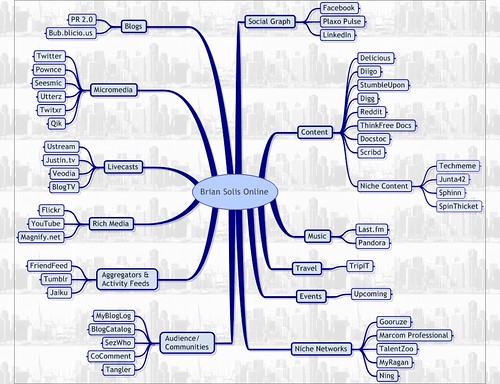
As conversations are increasingly distributed, everything begins with listening and observing. Doing so will help you identify exactly where relevant discussions are taking place, as well as their scale and frequency. This dialog can be charted into a targeted social map that’s unique to your brand. In the example below, I created a Social Map using MindJet to represent the communities where (if I were a brand) either need to or currently contribute based on my initial research.

This map is compelling as it demonstrates the scope of missed opportunities to the team and also decision makers. Consider running an audit and tracking the results in an accompanying document that measures and presents the rate of occurrence, whether each instance required a response, and if so, by whom, and also the potential reach of each dialog by quantifying the network of friends and friends of friends (FoFs) in order to establish priority, authority, response strategies, and urgency.
While we can’t control how our messages are internalized, we can surely shape perception at the point of discourse.
Remember, it’s what you say about you, what they hear, how they share that story, and how you weave that insight into future conversations.
The Conversation Prism is a living, breathing representation of Social Media and will evolve as services and conversation channels emerge, fuse, and dissipate.
In the social economy, relationships are the new currency and in Socialized Media, you will earn the relationships you deserve, in the individual communities where stakeholders and influencer assemble.