Oct 31, 2010

A Graphic Guide to Facebook Portraits


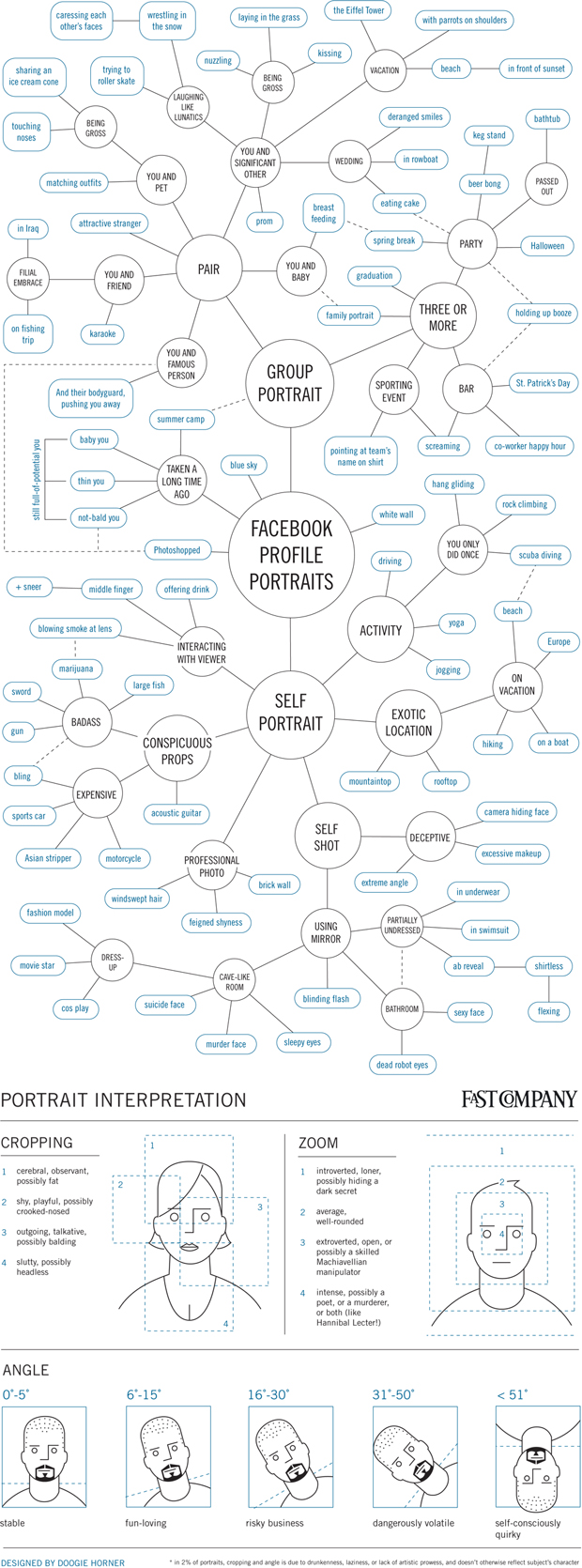
As a new strain of Social Network fever infects the nation, and you finally decide to share your face with the world, get the lay of the virtual land with our own open graph of portrait types.


Everyone is aware of how significantly Facebook has impacted modern technologies such as online communication, information aggregation, and boyfriend stalking. Less noticed, but just as profound, is its influence on art. Just as refinements in mirror crafting led to an increase in self portrait production during the Renaissance, Facebook's steady, unrelenting invasion of every crevice in the civilized world has led to a new renaissance in portraiture, notable for its creation by people who wouldn't know good art if it friend requested them.
These office workers and bored teens have replaced Okies and deranged shut-ins as the ultimate outsider artists; not only do they lack formal artistic training, most lack even the desire to create art. However, with this humble, ad hoc genre a complex visual dialogue has emerged, and its unique vocabulary reveals much about the modern world. Like all art forms, Facebook portraiture has its own lazy tropes—the laptop camera shot, the blue sky background, the blinding flash in a bathroom mirror—but even these thoughtlessly captured snapshots yield unintended insights about their subjects: How is the photo cropped? Can we see the subject's abs? Why is she giving us the finger? (See Portrait Interpretation key below.)
This chart will hopefully help you view specific Facebook portraits within the context of the larger genre, and therefore lead to a richer, more complex appreciation of Facebook portraiture as an emerging form of banal, eye-numbing expression.

NOTE: Choosing a literal or figurative avatar for your Facebook profile—a cartoon drawing, a famous person you think you look like (but which you don't), a flower, a beach—is a popular option, but since it isn't portraiture in the traditional sense, it is not covered in this chart.
Doogie Horner is the author of Everything Explained Through Flowcharts (Harper Collins, 2010) and Dirty Jokes Every Man Should Know (Quirk, 2009).

Oct 24, 2010

Don't Fall Into the Trap of A/B Testing Minutiae


Jason Cohen recently authored a post on A/B testing that deserves both broader awareness and a deeper dive. Most of us in the online marketing world are aware of the power A/B tests can bring through improved click-through, sign-up and conversion rates. Getting a higher percentage of visitors to a page to take a desired action is powerful stuff.
The process by which we hypothesize, design, create and run testing, however, is fraught with peril. And, one of the least obvious, but most insiduous potential pitfalls is actually what we choose to test.

Visualizing the "Local Minimum" Issue

A/B Testing Individual Landing Page Elements
It's definitely interesting and sometimes worthwhile to test individual elements of a landing page, but it's often not appropriate at the beginning of a landing page or product's life. As Conversion Rate Experts points out, the "let's throw stuff at a wall and see what sticks" approach can have a small impact. Researching the questions visitors have and answering them effectively can make a world of difference.
The problem is, it's so very tempting to be seduced by an easy answer.

The Tantalizing Tease of Testing Minutiae

 A/B Testing Trap
It's likely that many of you have read case studies like the ones below:
In all of these, some simple change accounted for big increases in click-through or conversion rate, leading to widespread praise and sharing. The problem is - they're the exception, not the rule. In fact, that's precisely why they're newsworthy and get so many mentions. That's not to say you shouldn't read them or shouldn't take away value from the examples (you definitely should). It's just that the mentality of the small change can create a misleading mindset for marketers.
Very few websites have the experience of changing a button color or altering a headline or fiddling with some copy and seeing huge improvements in conversion rate. If you have good reason to believe you're an outlier, go for it, just be cautious - it's not just the fact that small scale changes can have less positive of an impact. They also cost time and resources that you can't afford.

Some Simple, Compelling Math to Keep You Out of the Weeds

Let's say you're pretty good at conversion rate optimization - A/B and multivariate tests are relatively easy for you to perform and you've got solid instincts around them. And let's also say that you get reasonably decent traffic to your landing/test pages - in the several thousand range each day.
Even under these ideal conditions, massive problems emerge.
A/B Testing Options
Knowing that each test takes a substantial amount of time to get high confidence of accuracy and that smaller tests (with less needle-moving potential) take MORE time is a pretty convincing reason to start out with the big ideas and big changes first. But, it's not the only logic behind this. Let's say you find a page/concept you're relatively happy with and start testing the little things - optimizing around the local minimum. You might run tests for 4-6 months, eek out a 5% improvement in your overall conversion rate and feel pretty good.
Until...
You run another big, new idea in a test and improve further. Now you know you've been wasting your time optimizing and perfecting a page whose overall concept isn't as good as the new, rough, unoptimized page you've just tested for the first time.
It's easy to see how you can get lost in this process and frustrated, too. That's why my recommendation (and the advice I get from lots of talented CRO folks) is to start with the big ideas and big projects, nail down the grand plans worth testing, let your audience pick a winner and then try to tweak, tune and improve.

What You Should Be Testing

What do I mean when I say "big ideas" and "overhauls?" Luckily, 37Signals provided a terrific example yesterday with their Basecamp Homepage Redesign:
Old Basecamp Homepage vs. New
They recorded a 14% improvement from new vs. old and can now decide whether they want to try another innovative concept or start optimizing the little things on this version. And while the numbers don't sound as compelling as a few of the bigger ones from the small tests, I'd argue they're going about things exactly in the right way. Perhaps a "little change" to the old version would have improved things quite substantially, but with this new version, they've got a higher base conversion rate and can benefit from every change that much more.
Another great example is the case study Conversion Rate Experts did for SEOmoz itself. That test gave us a 52% improvement in conversion rate from the PRO landing page. As an addendum, in April of this year, we tested an in-house created, shorter, less story-like landing page that we all hoped would beat out the old long-form version. After a few weeks of testing, it lost out. Later this summer, we'll be trying something completely different in an attempt to beat our current best.
The process to follow for conversion rate optimization and testing was well described in Stephen Pavlovich's post - The Definitive How-to Guide for CRO. His PDF guide, in particular, made this dead easy:
CRO Process Step 1
Step 1 of 4 in the process
Follow those steps, don't get lost in the minutiae, and you'll be on your way to exceptional results - no thousand monkeys with typewriters required.
p.s. I'd also suggest checking out this long but worthwhile post on stats for usability (and A/B) tests.

Oct 22, 2010

Group Deal Application of Wildfire on Facebook

Source: Wildfire

Overview
They’re excited to launch Group Deals, the first social buying application for Facebook Fan Pages and Facebook Connect! With a Group Deal any business, whether it’s a large brand, an agency or a small or medium sized business, can easily and cost-effectively sell their product or service in a socially engaging way on Facebook or on their website. You may have heard of the awesome success of companies like Groupon that make buying fun and social. Now with the launch of our Group Deals format companies of all sizes can create their own Groupon-like deal within minutes and publish it on their fan page and/or their website. Group deals are the ideal way to make buying both fun and social!
How it WorksFor those of you who don’t know what a Group Deal is here’s how it works:
  1. Your company offers its Facebook fans a special deal on a product or service at an awesome price – but the deal only activates if enough people commit to buy the deal (e.g. “get a appetizer, entre and desert for $15 if 50 people commit to buy this deal”)
  2. Consumers commit to the deal by providing their contact information and their credit card details (we collect this via PayPal).
  3. If the minimum number of consumers commit to the deal before the deadline, the deal activates and consumers’ credit cards are charged. We automatically email the consumers with instructions for redeeming their deal. If the minimum number is not reached, consumers’ cards are not charged and we email them to let them know the deal is off.
Wildfire takes care of the entire process of running a group deal – all you need to do is define the value of your deal, the minimum number of buyers required and the duration of the campaign!
Top 7 Reasons to run a Group Deal
  1. It’s a great way to make selling to social network users fun, social and engaging
  2. It’s a powerful way to encourage word of mouth spread about your company’s product or service
  3. It’s a great tool for selling old stock or unsold inventory
  4. It encourages regular engagement with a company’s Facebook Fan Page or Website (e.g. by offering regular weekly group deals)
  5. It’s easy to set-up – campaigns can be live within minutes
  6. It’s highly affordable and scalable
  7. It’s secure through PayPal’s verification process
Note on Fraud & SecurityThey’ve partnered with PayPal to provide a secure and scalable solution for your company to run financial transactions and for consumers to buy Group Deals from companies that are PayPal verified. This way there is minimal risk that consumers will engage in fraudulent transactions and your business can be assured that funds we’ll be collected.

Oct 19, 2010

Casual Gaming Can Help you Achieve your Life Goals

Posted by Lauren Dugan on August 3rd, 2010 3:30 PM


The alarm’s shrill screech is piercing your ears while the clock flashes 5AM, but instead of going for that 2 mile jog you were determined to start incorporating into your morning routine, you hit the snooze for another hour. Getting out of bed to exercise before you start your day is no easy feat, but Mindbloom hopes to make it possible by giving you your very own virtual life tree to grow, nurture and care for in a creative mashup of social gaming, networking and media sharing. Infusing each individual’s quest for personal wellbeing with fun and interactive tracking, goal-setting and casual gaming, Mindbloom is a service that’s on the cutting edge of new media in a new age.

Casual Gaming

The core of Mindbloom’s Life Game is casual gaming. When you set up an account, you are given a Life Tree to care for. This tree has branches that represent major areas of your life, such as your career, family and health. Each leaf on the branch represents small goals within each of these areas.
Your leaves are defined by specific actions that you create – such as going for an early morning jog or taking the stairs over the elevator – and they will turn brown if you do not complete these actions. If you do, you’ll receive seeds to keep your tree healthy and unlock new features. Users can also add inspirational images and quotes to each leaf to keep themselves motivated.
mindbloom 1

Social Networking

Within the goals of keeping your tree alive is a robust use of social networking. Mindbloom encourages users to share their trees with friends and family, and to create a profile that clearly displays their goals so that they can receive encouragement and support. They also have a “Humblebee” that floats around the site and asks users to congratulate their friends for achieving large life goals, and doling out seeds for positive interaction.
Mindbloom’s Life Game also allows users to connect via Facebook and share their successes on their wall. Other social elements include the ability to create “forests” of people who you want to keep track of, a messaging service, and email notifications of your friends’ successes.

Enterprise Solutions

Mindbloom offers its services to businesses and organizations looking for a way to encourage their members to live a healthy lifestyle. The most recent business to incorporate Mindbloom’s platform within its offerings is Sacramento State ‘s health and wellness facility, also known as The WELL (Wellness, Education, Leisure, Lifestyle). Providing over 25,000 staff and students with a support system for healthy living, The WELL has created its own branded content within Mindbloom’s Life Game to encourage its members to achieve their personal wellbeing goals.
Mindbloom has created a fun way to remind yourself of your life goals, and remain accountable to yourself and others. That Life Tree that you’ve got to care for is a compelling reason to turn your alarm off, rub the sleep out of your eyes and finally go for that jog.

Oct 18, 2010

MOKO – a beautiful Chinese social network


Originally posted on The Peking Order.
The Peking Order is committed to seeking out exciting media phenomena in China, especially when those exciting media phenomena involve half-naked women. This week, Beij 3 features MOKO.cc – an extremely popular Chinese social network that appeals both to the narcissism of women in China and the lust of humans everywhere.

The premise is simple, just like Myspace or Facebook, members have a personal profile that allows them to list basic information and upload photos. So that members can be spotted and make network connections, they can be listed under various titles, i.e. Actor, Still Model, Car Show Girl, Producer, etc.
However, the reasons that MOKO looks so good are also the things that make it different from other social network sites:
1. There is a selective registration process. According to the site, only 10 percent of applicants get through the initial screening. What it is not mentioned are the criteria are used to choose members. Although it could be that the unlucky 90 percent did not fill out their form correctly, a quick look at member profiles (a “quick look” will be impossible for many) would suggest it has a lot to do with looks.
2. The site has an offline presence. MOKO has a number of successful partnerships with magazines like Maxim and FHM, as well as Beijing nightspots, like LAN Club, which hosts regular MOKO parties.
3. MOKO makes photos look good. Once a member, people can apply to be a MOKO Top Girl (or a MOKO Top Man). Once accepted, members are invited for an interview and a photo shoot, all free of charge. The photos taken at the shoot are the photos you see all over the site. If you wonder why the some of the girls look too good to be true, they probably are – MOKO boasts that it photoshops the photos, also free of charge.
4. There is a voting system. The votes of unregistered viewers are worth one point, the votes of members are worth five. Meet Zhang Yinghan, who currently leads the MOKO Top Girl ranking with 164,802 votes:

RenRen shifts marketing focus to social gaming

If their latest ad campaign is anything to go by, RenRen – China’s answer to Facebook – seems to have shifted its marketing focus to social gaming:

The animated animals, vegetables and furniture are references to China’s leading social games, which allow users to manage virtual farms, vegetable patches and restaurants.
The message and tone of this campaign contrasts with its campaign last year, which showcased ‘real-life’ stories of people using RenRen to connect:
Adquan.com (Chinese) claims that this shift is RenRen’s answer to the much-discussed question of whether China’s online social networks are for meeting new people or allowing existing friends to play.
This might be going a little far, since Chinese social networks can provide both services simultaneously. For me, however, the new campaign at least highlights one thing: that social gaming is currently far more important to Chinese online social networks than their Western counterparts.

A Chinese lesson for social media people


.
Although it’s the policy of Angry Editor (my pedantic English-correcting alter-ego) not to teach new vocabulary, I am making an exception on this blog. The following is a list of 50 words that I’ve needed when talking to people about social media, when attending  Ogilvy’s Chinese social media trainings, and when reading about social media on Chinese blogs and websites:
.
Social Media: 社会媒体 shèhuì méitǐ; 社交媒体 shèjiāo méitǐ; 社会化媒体 shèhuìhuàméitǐ; 社媒 shèméi
Blog: 博客 bókè
To blog:  写博客 xiě bókè (lit. “to write a blog” – the noun “blog” in Chinese does not double as a verb).
Blogosphere: 博客圈 bókèquān
Blogger: 博主 bózhǔ; 博客写手 bókè xiěshǒu
Social gaming: 社会游戏 shèhuì yóuxì; 社交游戏 shèjiāo yóuxì
To visit: 访问 fǎngwèn
To register / to sign up: 注册 zhùcè
To sign in: 登录 dēnglù
Online shopping: 网上购物 wǎngshàng gòuwù
Podcast: 播客 bōkè (careful with the tones!)
Microblog: 微博 wēibó
SNS (Social network site): 社区网站 shèqūwǎngzhàn,
To embed: 嵌入 qiànrù
To upload: 上传 shàngchuán
To download: 下载  xiàzài
Hitcount: 点击量 diǎnjīliàng
Photo-sharing site: 相片分享网站 xiàngpiàn fēnxiǎng wǎngzhàn
Video-sharing site: 视频分享网站 shìpín fēnxiǎng wǎngzhàn
Streaming video: 流视频 liú shìpín
Video blog: 视频博客 shìpín bókè
Viral video: 病毒视频 bìngdú shìpín
Video clip: 视频 shìpín
Forum: BBS
Social media marketing: 社会化媒体营销 shèhuìhuà méitǐ yíngxiāo
Crowd sourcing: 众包 zhòngbāo
API (Application Programming Interface): 应用编程接口 yìngyòng biānchéng jiēkǒu
Location-based service: 定位服务 dìngwèi fúwù
Augmented reality: 现实增强 xiànshí zēngqiáng
Desktop client: 桌面客户端 zhuōmiàn kèhùduān
Mobile phone client: 手机客户端 shǒujī kèhùduān
App (iPhone etc.): 应用程序 yīngyòng chéngxù
Interface: 界面 jièmiàn
Search engine: 搜索引擎 sōusuǒ yǐnqíng
Search engine optimization (SEO): 搜索引擎优化 sōusuǒ yǐnqíng yōuhuà; 搜索优化 sōusuǒ yōuhuà
Firewall: 防火墙 fánghuǒqiáng
VPN (Virtual private network): 虚拟个人网络 xūnǐ gèrén wǎngluò
Proxy server: 代理服务器 dàilǐ fúwùqì
Guest post: 来宾/客座博客文章 láibīn/kèzuò bókè wénzhāng
Paywall: 收费墙 shōufèi qiáng
Real-name: 实名 shímíng
RSS: 订阅 dìngyuè
RSS reader: RSS阅读器
Browser: 浏览器 liúlǎnqì
Viral marketing: 病毒式营销 bìngdúshì yíngxiāo
Censorship: 审查 shěnchá
Chatroom: 聊天室 liáotiānshì
New media: 新媒体 xīnméitǐ
Social/new media douchebagI’m not aware of an equivalent Chinese word for this, or even if it is a concept talked about in Chinese. So far, I have had two suggestions: “社媒SB” [THX @kaiserkuo] and “煤渣 (lit. coal residue)” [THX @alfieinwander]…
There are certain to be alternative expressions for some of these words and I’m sure I will have missed some important social media vocabulary out. Please let me know if you have any suggestions.