Apr 24, 2010

I Think Facebook Just Seized Control Of The Internet

by MG Siegler on Apr 21, 2010


The opening keynote at Facebook’s f8 conference today in San Francisco was short and sweet. But don’t let that fool you. It contained some huge announcements pertaining to how the service will interact with the broader web going forward. The three big ones: social plugins, Open Graph, and Open Graph API, make Facebook’s intentions very clear: they want to be the fabric of the web.
Erick already outlined Facebook CEO Mark Zuckerberg’s perspective on this from his keynote, but perhaps more interesting was some of what Platform Lead Bret Taylor had to say. The most interesting thing Taylor said was that Facebook’s stance is that social connections are going to be just as important going forward as hyperlinks have been for the web. Obviously, as the largest social network, Facebook to some degree has to believe (or at least say) that. But today, and really over the past several months of huge growth, Facebook has given us all a reason to believe that may be the case.
And if that’s so, Google had better watch out. There may be a new sheriff in web town.
Right off the bat, Zuckerberg rattled off some impressive numbers. While we all know that Facebook has over 400 million users (and it appears to be approaching 500 million rapidly), he also said that the service is growing at a faster rate than ever before. That’s fairly insane. He also noted that while it took the service 5 years to get to 100 million users, it took only 3 years to reach the same total in terms of mobile users. And in the past year, they seen that number grow 3x. Perhaps most impressive of all is that in just one year, Facebook got 100 million people using Facebook Connect. And that’s why everything they announced today has a real shot at completely transforming the web. Because everything they’ve announced (and specifically, Open Graph) seems to be like Facebook Connect on steroids.
All of this may sound grandiose and a bit frightening, but that’s why it’s ingenious the way Facebook is using Taylor. As he explained on stage today, Taylor used to work on a “small social network called FriendFeed” (which, of course, Facebook acquired last year). While he’s now a key member of Facebook’s team leading this new strategy, he used some of his keynote today to talk about his experience working on a startup with Facebook Connect.
He noted that at FriendFeed they found that the key to getting users to stick around and keep them using the site was that they had to connect with five friends. Unfortunately, when you’re a startup with not very many users, that’s extremely hard to do (yes, even just five). So FriendFeed implemented all types of logins and email contact lookups to try and help users find friends. The key to FriendFeed’s growth was Facebook Connect, as users were four times more likely to become engaged users if they signed up through that service, he said. In fact, if FriendFeed has continued on as an independent service, “we would have removed all those other signup buttons,” Taylor said. Yes, that includes Twitter and Google.
And lest you think his experience with Connect was all peachy, Taylor went on to explain that FriendFeed was constantly frustrated with how difficult Facebook Connect was to implement into their site. This is something that many developers have echoed over the past year. But with the new social plugins announced today, that all changes, Taylor promised. “I didn’t think the platform needed to be this complex,” he said. And now, apparently, it isn’t.
So that’s Taylor selling Facebook’s Open Graph to thousands of startups out there. And many are likely to bite. There’s no denying that social graphs are the key to a service being sticky, and there is no better social graph than Facebook’s.
Companies will have to choose whether to fight against this, and attempt to launch their own graph, or get in line. “When we connect our graphs together, the web is gonna get a whole lot better,” Zuckerberg promised.
Facebook launched some of this social plugin and Open Graph integration with several (30) large partners today. Just clicking around the web earlier, I ran into the new “like” button on CNN. It’s excellent; much better than the current share buttons which are slow and clunky in comparison.
In my opinion, Facebook still has a ways to go towards improving its actual site if it’s really going to be the long-term center of the web. (As in, the place you go to rather than Google.com.) But its claws for pulling in outside content are now razor-sharp. It’s going to be very hard for anyone to escape.
Over the next several days and weeks, we’ll undoubtedly hear why that’s a bad thing. Maybe it is. But maybe, if Facebook plays its cards right, the web will be a bit better because it will be more connected. Of course, that’s a lot of power for a still-private company to have. Let’s hope they know what they’re doing, and aren’t evil.
[photos: flickr/ingridtaylar and flickr/alan vernon]
Read more: http://techcrunch.com/2010/04/21/facebook/#ixzz0lyuygFbV

Apr 23, 2010

Facebook had more than 1 billion likes on the web in just 24 hours

by MG Siegler on Apr 21, 2010


Today at Facebook’s f8 conference in San Francisco, CEO Mark Zuckerberg made what seemed like a bold prediction. Only he didn’t think it was that bold. According to Zuckerberg, there will be over 1 billion likes across the web in the just first 24 hours of the “Like” button. It launches today.
Zuckerberg can say this because there are already some 30 huge partners Facebook is launching these new features with. And I do mean huge. Huge as in CNN, ESPN, and IMDb, among others. Each of these sites will have Facebook buttons implemented and working today.
The Like button works exactly like it does on Facebook (and other sites like FriendFeed): it allows users to show their approval of any piece of content on these sites with one click. You can also include a little note saying why you like the item (see screenshot below). We wrote about its impending launch a few weeks ago. These likes are then transported back to Facebook and integrated into users’ profiles. Notably, if you like a movie on IMDb, it will be pushed into your favorite movies area on your Facebook profile.
Earlier in the presentation, Platform Lead Bret Taylor rattled off another huge stat: Facebook users are sharing over 25 billion things a month currently. With the new Like button (and the other new social plugins, not to mention the Open Graph itself), and Facebook’s new partners, expect this number to surge. I mean, if Facebook is going to serve up 1 billion likes just today, they’ll be on pace for a least 30 billion shares this month, not counting any other method of sharing on the site.


Read more: http://techcrunch.com/2010/04/21/facebook-like-button/#ixzz0lvWJ0bTZ

Zynga spends between $5 million and $8 million per month for banner ads on Facebook


The game company can keep growing as long as it stays in Facebook's good graces


"The next three years are a hell of a lot harder than the last three"
More than 120 million people play Zynga's online games. Employee headcount has almost quadrupled in the past year, to 775. Revenue for the three-year-old company should surpass $450 million in 2010, according to two people who have been briefed on its financials.
Mind you, Zynga's games are free. Revenue mostly comes from selling virtual hoes and machine guns and such to players of FarmVille, Mafia Wars, and other titles. "Only a few companies are so privileged to get the rocketship growth that Zynga has," says Reid Hoffman, co-founder of LinkedIn and a Zynga director and investor. As for an initial public offering, "All options are on the table," he says.
In an interview at Zynga's overflowing offices in San Francisco, Mark Pincus, the company's 44-year-old founder and CEO, seems giddy. "It's fun," he says, swiveling back and forth in a conference room chair. "It's adrenaline."
It's a sweet gig—although there's one big unknown: Facebook. Zynga's success depends on the good graces of the social network, where almost all of its games are played. "The single biggest challenge is managing growth in the face of total uncertainty," says Pincus. By all accounts he's on friendly terms with Facebook founder Mark Zuckerberg—who has shown a willingness to knock heads.
In March the social network stopped letting Zynga and other app creators promote games in the "notifications" menu users see each time they log on. Facebook said users were complaining about spam-like messages that appeared every time one of their game-playing friends found a baby duck or whacked a mobster. One protest group on Facebook with more than 5 million users called itself "I Don't Care About Your Farm, Or Your Fish, Or Your Park, Or Your Mafia!!!"
Pincus says the policy change has hurt his business in "the short term" by slowing traffic to his games in the first quarter of this year. Still, he says, Zynga and Facebook can help each other, since his company's wares increase the time and attention users spend on the social network. He compares the relationship to that of a cable company and a hit-making network: "I think it benefits Facebook's users if we can create the next Sopranos and if we can be a brand, like HBO, that their customers really want." (Pincus is a minority investor in Facebook. All he'll say about his stake is that it's "basis points.")
Facebook doesn't just get happier users, it also gets big checks from Zynga. Any time a game looks like a potential hit, Pincus says his company deploys millions of dollars on ads promoting it to members of the social network. In total, Zynga spends between $5 million and $8 million per month for banner ads on Facebook, according to NeXt Up! Research. The aggressive promotions make it difficult for rivals to copy an idea for a game and make it as successful as Zynga's version, says Lisa Marino, chief revenue officer of app startup RockYou. "Social gaming is a math equation," says Marino. "When you put millions of dollars down to protect [a franchise], you will win it."
Facebook could force Zynga to adjust its math. More than 90% of the company's revenues come from users converting real cash into proprietary virtual currency. FarmVille, for example, has Farm Coins. Say you buy a tractor for 5,000 Farm Coins, which equals about $3.30. Typically the company pays less than 10% of that to a third-party transaction handler such as PayPal and keeps the rest. (In March, PayPal said Zynga was its second-largest merchant after eBay.)
Facebook is testing a service called Facebook Credits that would offer a single virtual currency for use on many different apps. If the social network forces app makers to use Facebook Credits, as some developers expect will happen this year, Zynga would have to pay the company up to 30% of every transaction. "If Credits become pervasive, I don't think Pincus can stop it. It's going to hit the margin," says Peter Relan, executive chairman of CrowdStar, one of Zynga's many competitors.
"There's just going to be one currency that people use" on all apps, Zuckerberg told Bloomberg TV on Apr. 21. He didn't say when Credits might become mandatory. Pincus is trying out the currency as an option in FarmVille and other games. "There is definite value for users and developers in having the trusted Facebook brand associated with buying virtual goods," he says.
Pincus says he's eyeing other ways to get his games in front of the masses. Apple's (AAPL) announcement on Apr. 8 that it plans to include a program for connecting people in social games played on the iPhone and iPad caught his attention: "It would make a lot of sense for Apple to be interested in doing more to enable social gaming," he says.
For now, Zynga's mission is to keep cranking out those Facebook hits. Work is going on around the clock; Pincus is encouraging employees to develop pet projects during weekend-long programming marathons. And, of course, the company is hiring like crazy. To help fill 300 job openings, it's running an ad on a billboard in San Francisco and has bought local public-radio sponsorships.
Pincus will need all the intensity he can get. Electronic Arts (ERTS) upped the ante in November when it bought Zynga rival Playfish for $275 million. "Zynga is riding high," says Barry Cottle, general manager of EA's interactive unit. "But they may soon find out that the next three years are a hell of a lot harder than the last three."
The bottom line: As long as Zynga keeps supplying Facebook with hit games—and ad revenue—this could be a long and profitable partnership.
Douglas MacMillan is a staff writer for Bloomberg BusinessWeek in New York.

Will Social Strategizing Bring ROI?

APRIL 22, 2010

One-half of companies have a social strategy


A majority of US marketing professionals claim social media is now “invaluable” to their business, according to April 2010 research from online marketing firmR2integrated.
While relatively few marketers reported social was pointless and overhyped or too complicated to deal with, most are still not increasing revenues or otherwise profiting from their social efforts.
Although one-half of respondents said they had a social strategy in place—considered critical for success in the social space—only 35% thought they were making money.

US Marketing Professionals Who Believe Their Company Has Increased Revenues or Profited from Using Social Media, April 2010 (% of respondents)

Strategy does help, though. Respondents who said they profited were twice as likely to have a formal strategy. They were also more likely to have staff dedicated to managing social media.
Marketers’ main goal in implementing a strategy was better lead generation, followed by brand monitoring.
The biggest obstacle for social strategies was not having enough data to come up with a measure of return on investment. Management buy-in was also a problem, and more than one-fifth of respondents said their audience was not active on social media.

Main Obstacle to Implementing a Social Media Strategy According to US Marketing Professionals, April 2010 (% of respondents)

“Marketers clearly recognize the need for, and see the potential of, social media, but are still trying to develop models that increase real engagement which then leads to profitability—if that’s a goal for implementing a social strategy,” said Matt Goddard, CEO of R2integrated, in a statement.
“Despite the presence and popularity of social media, many companies remain relatively unfamiliar with its practices, pundits, and principles,” he said.
Marketing management firm Unica reported in March 2010 that strategic integration of social with other marketing efforts varied by channel. MarketingSherpa found that in late 2009 only one-quarter of social media marketers had reached the strategic phase.
Keep your business ahead of the digital curve. Learn more about becoming an eMarketer Total Access client today.
Check out today’s other article, “Finding Consumers Who Are Ready to Buy.”   

Apr 20, 2010

Facebook Commanded 41percent of Social Media Traffic


Facebook and YouTube are displacing rivals and taking over the social web, according to data we’ve just received from comScore.
In addition to showing massive and continued traffic growth throughout 2009 and the beginning of 2010, Facebook and YouTube (YouTube) continued to capture the highest volume of social web traffic. Twitter (Twitter) also garnered a ton of mainstream attention, helping the company increase the number of visitors to its site by fivefold over the course of the year.

Taking a look at the unique visitors charts, we see the widespread migration from MySpace () to Facebook even more clearly. As of March 2010, Facebook traffic made up 41% of all traffic on a list of popular social destinations. MySpace was in second place, capturing around 24% of traffic. Gmail () had 15%, and Twitter had 8%. However, during the same period in 2009, MySpace was in the lead with 38% of site visits over Facebook’s 33%.

While Gmail continues to show slow year-over-year growth and sites such as LinkedIn () and Twitter experienced exponential gains over the course of the past 12 months, MySpace’s traffic has been completely stagnant. Facebook, on the other hand, has exhibited strong growth and high volumes of traffic. Take a look at the difference between site traffic in March 2009 and March 2010 for these social sites:

comScore is an acknowledged leader in digital analytics and intelligence. comScore’s data for this post are based on a hybrid of site analytics and audience measurement for U.S. users at home, work and school.

Apr 15, 2010

World’s Greatest Sales Person Campaign of Ogilvy

In order to celebrate the craftsmanship of selling, OgilvyOne created a contest with an objective to sell a red brick. In a branded YouTube channel, future sales experts are able to view the briefing, upload a video and check out other contestants. The price? Become a finalist and Ogilvy will fly you to Cannes to pitch a product. Win the pitch and you’ll receive a three months paid fellowship at Ogilvy and the title World Greatest Salesperson.


Continue reading for more insights in the campaign, opinions and the videos of the campaign.

About the campaign

Agency Ogilvy, famous for its respected founder David Ogilvy, loves to tell the rich story of how a door to door salesperson became the founder of one of the biggest advertisement agencies in the history. To continue this passion for sales, Ogilvy launched nine videos showing a various types of sales techniques. From The Metaphor to The Envy Transfer. My most favorite? The Stat Factor.


YouTube Preview 
Image

Up until now, the videos didn’t receive that much attention overall. The nine different videos received a total of 35.000 views.
According to Brian Fetherstonhaugh, chairman and chief executive at OgilvyOne in New York Salesmanship has been lost in the pursuit of art or the dazzle of technology. Salesmanship needs to be rekindled in this postrecession environment, as consumers are making more informed and deliberate choices. With the consumer in control, selling is less about intrusion and repetition, and more about engagement and evangelizing.
The consumer is in control. This means selling is less about intrusion and repetition and more about engagement and evangelizing.
- Brian Fetherstonhaugh

About the competition

The competition started two weeks ago and received 8 entries up till now, which is an incredible low number compared to the amount of videos uploaded for the Island Reef Job Best Job In The World campaign. An odd comparison? Of course both target audiences can’t be compared, but it does tell something about the effort people are willing to spend on gaining a job via a YouTube video, which requires some research, creativity and effort. Current submissions include semi professional and well thought entries, as well as low quality webcam videos.

Conclusion

In my opinion a great campaign with high potential to gain attention and awareness from both the human resource perspective as a way to tell the story behind Ogilvy. Hopefully Ogilvy will be able to gain more attention to this campaign; it would be a waste if the campaign will end with a low amount of contestants and publicity.
Sources: ThisIsOgilvy.com, NYTimes.
http://www.linkedin.com/companies/ogilvyone

2010: Twitter Has 105 Million Registered Users

In kicking off Twitter’s Chirp developer conference, the company finally revealed its long mysterious registered user number, and it’s surprisingly large (based on some prior outside estimates): 105 million, or to be exact, 105,779,710, according to a slide showing behind Co-founder Biz Stone during his opening remarks.
The growth’s not over either — Twitter says its still adding 300,000 users per day. Moreover, as many have speculated, most of Twitter’s traffic — 75% of it in fact — comes from third-party clients and applications.
Twitter also says that it’s seeing 600 million search queries per day, which gives us a sense of the reach of the company’s new “Promoted Tweets” platform.
While those numbers still put the company’s user count significantly behind that of Facebook (which recently passed 400 million users) the gap is narrower than many probably perceived.
More to come …

Social networks around the world 2010

Google has Twitter timeline search

by Jay Hathaway (RSS feed) Apr 14th 2010 at 3:02PM
Google's venture into real-time search just got a lot more serious, with a new Twitter timeline feature. Like Twitter's own search, Google's Twitter timeline can tell you what people are saying about your search term right now. Google's done one better, though, by indexing tweets back to the beginning of time (well, the beginning of Twitter, anyway), and displaying an activity graph that shows you when tweets about your topic spiked.

The implications of indexing every tweet and making them all searchable are pretty huge. I'm excited to be able to go back and find some of the funny tweets I wrote a couple of years ago, but you might not be excited that people can find all the mean things you said about your boss before he discovered Twitter. Don't worry, though, deleting a tweet will wipe it out of Google's results, too.

It's interesting that Google made this move the day after Twitter announced Promoted Tweets on its search page. Can you use Google to skip Twitter's search and thereby skip its ads? On the other hand, it makes sense to launch a new Twitter feature on the opening day of Twitter's Chirp Conference for developers. It'll give them something to talk about in San Francisco.

[via CNET]


Don't miss a thing! Free update by email. Enter your email address:

FarmVille script and extention cheating

You'd be lying if you said you'd never tried FarmVille. Well, theoretically you could claim to be one of the few that has yet to try FarmVille, but with over 80 million users you're probably lying.

True, most of those 80 million are middle-aged housewives that think an 'extension' is a way of increasing the range of the vacuum cleaner, but by my reckoning there must be some Download Squad readers that also play FarmVille. This post's for you, power users; power farmers. Why calculate your crop harvests in your head when a userscript can do it for you?! Or, indeed, why should you spend time adopting animals and accepting bonuses when there are peas and asparagus to plant?

Remember, Chrome 4 and above supports Userscripts -- though where Chrome Extension versions exist, I have included a link. Firefox users will have to install Greasemonkey.

Let's start with the most basic of extensions -- a harvest calculator:

1. Farmville Harvest Calculator [Greasemonkey Userscript -- Chrome Extension]

Available for both Firefox and Chrome, this tool does exactly what it says on the tin -- calculate harvest times -- but, if you use the Chrome Extension, it also removes the ad bar down the right side! No longer will you be distracted by all the pretty single ladies while you farm. Don't Facebook realise that farming -- and gaming -- are far more important than finding an easy girl that wants to play with your hoe?

2. FarmVille Wall Manager [Greasemonkey Userscript -- Chrome Extension]

FarmVille Wall Manager, or FVWM, has a truly vast number of options. In essence it automates the process of scanning your Wall for FarmVille-related updates. By default it doesn't automate much, but by clicking the 'FVWM Options' on the left side bar of your Facebook News page you can enable the automation of everything.

It's hard to resist such menu options as 'Get free XP?' but there are even esoteric things, such as defining which kind of horse you want to adopt: maybe you want the pink pony foal, but not the white foal? White sheep but no black sheep? No problem!

Note: the developer says Facebook is trying to prevent the automation of this userscript/extension. If you refresh too often you might get banned -- so don't do it more than once per minute! Also, if you have problems getting the script to run, check the Userscript page -- Facebook URLs can be troublesome it seems.

3. FV Feed Filter [Chrome Extension -- Greasemonkey Userscript (not as good!)]

If, like me, you find automation a bit too cheaty, use the FarmVille Feed Filter instead! Click its button in Chrome (or visit the your filtered FarmVille Facebook page in Firefox) and you'll be rewarded with a very, er... quaint interface.

Better yet, you can hide the FarmVille updates on your main News Feed -- and just click the button when you want to FARM. I'm all for addictive gaming experiences, but it sure is nice to have the POSSIBILITY of getting away sometimes -- and that can be hard when your News Feed is full of delicious sheep and plants and free XPs...


4. Glitch/cheat/hack your way to stardom!

OK, there aren't any actual cheats in FarmVille, but there are definitely creative uses of the game's mechanics. The hay bale trap, for example. Then, because 'winning' in FarmVille is mostly about having the most XP and coins, you simply need to make sure you spend most of your time earning XP and getting coins -- so make sure you have as many neighbours as possible! By simply clicking 'Visit/Help Friend's Farm' you can earn a small fortune -- help 20 neighbours a day, if you have the time for it.

Once you have a steady stream of freebies from neighbours, the next step is efficiency. Making the most of what you've got. Fortunately, like every game out there, and because the Internet is awesome, there's a 10-part FarmVille power-levelling guide. It's pretty damn extensive, but if you really want to be the best...


5. Speed up FarmVille and increase responsiveness

As most gamers know, the single best way to improve your gaming performance is to speed things up: a faster Internet connection, a better graphics card, a de-fragmented hard drive! The same can be said for FarmVille, though of course the speed gains are mostly a matter of convenience.

On all but the most modern computers, FarmVille runs slowly. That's the power of Flash for you. There's simply no way a frickin' farming simulator should slow a 3-year-old computer down to a crawl -- and fortunately there's something you can do about it! First, drop the video quality by clicking the button in the top-left corner -- next, make sure your Flash player is up to date.

Finally, there are some fairly low-level tweaks you can make, to squeeze a little more performance out of Firefox: check our post from last year, or enable pipelining (but be careful). Chrome is already as fast as it gets, so I'm afraid I have no tips for you!

* * *
As always, if you've got a pro-farmer tip, leave it in the comments. We promise not to judge you...

Apr 12, 2010

The Revenue of Tencent in 2009


Originally posted at VentureBeat
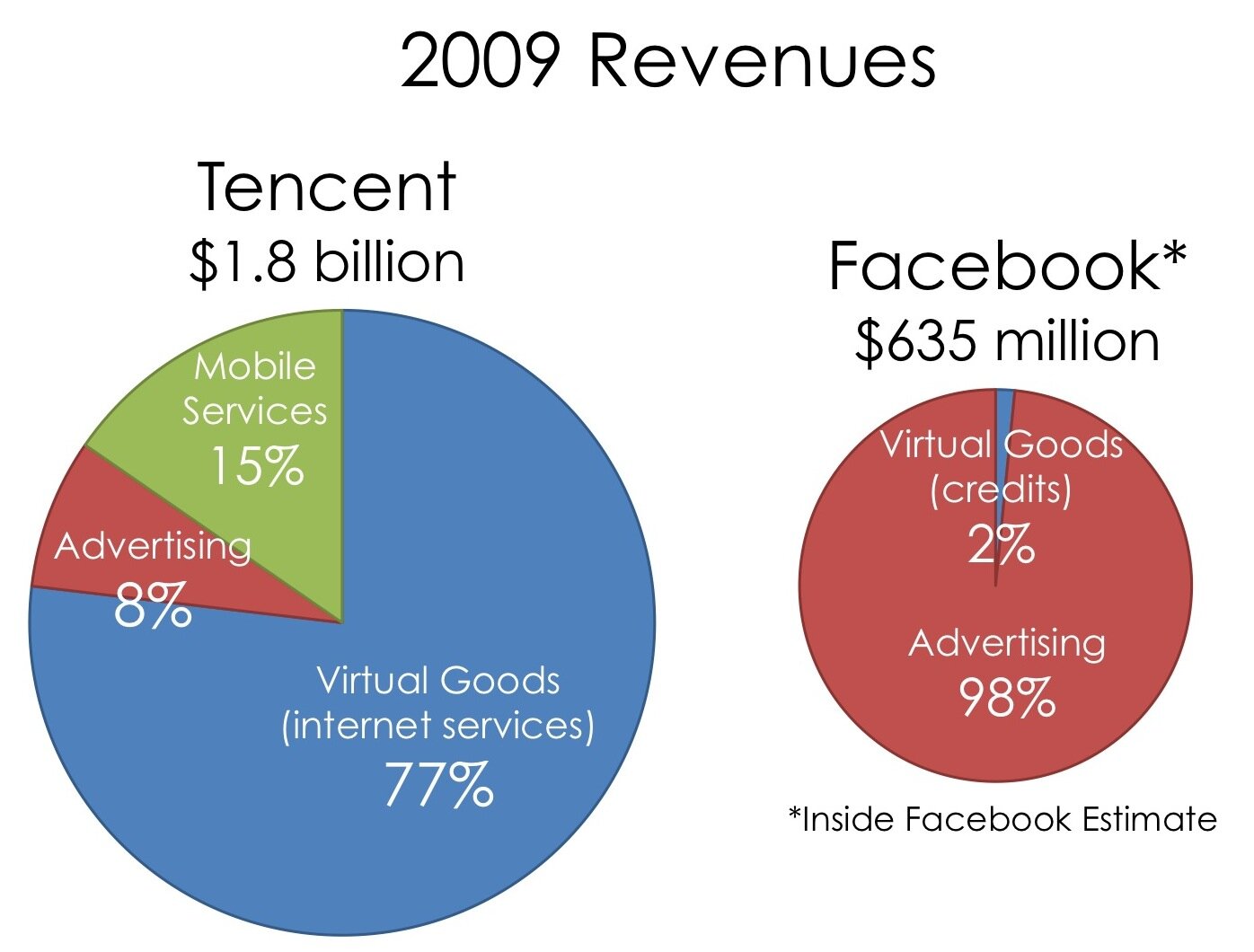
Tencent, a Chinese internet giant in instant messaging, social networks, and mobile, posted $1.8 billion in 2009 revenues, an increase of 74% from a year ago. For the record, that’s about three times Facebook’s estimated $600-700 million in 2009 revenues.
Tencent’s flagship product, QQ Messenger (with a cute penguin logo), is the first introduction to the internet for most Chinese teens. It claims a whopping 523 million active users. Tencent then cross-promotes its other online offerings: QQ Show, QQ Game, QQ Music, QQ Pets, and its social network, Qzone.
Tencent is the undisputed world leader in micropayments. Each QQ service is connected to a “diamond membership” of a different color, that offers free and exclusive virtual goods. For instance, the “red diamond” membership helps you dress up your avatar for face-offs against other online fashionistas in QQ Show. About 10% of Tencent’s active users pay for such memberships, which cost around $1.50 per month. Over 75% of total revenues come from these “internet value-added services,” which grew 94% in 2009.
By comparison, Facebook generated under 2% of revenues from virtual goods according to an estimate from Inside Facebook, though that number should rise with the full-fledged introduction of Facebook Credits in 2010. Facebook could learn from Tencent that monthly memberships work better than relying solely upon one-off purchases of credits.
Tencent also probed international waters in 2009, including the Facebook platform. It launched a puzzle game, called Treasure Hunter, as a “market research project” to test the Facebook market for synchronous casual games.
Richard Peng, vice-president of corporate development at Tencent, comments, “Tencent is expanding globally, but we are being very cautious. We want to do this the right way, using proper planning and methodology, and we are circumspect about making big mistakes that could kill our business. Because of our cultural sensitivity and sophistication, we are starting off in places that are culturally very close to China – such as Vietnam and Southeast Asia. Once we develop a certain level of experience there, we’ll see about entering the U.S.”
There are however indications that Tencent is losing its innovative edge. It spotted the social networking trend early, but failed to expand beyond its core demographic of teens, a long-standing objective for the company. Instead, its competitors, social networks Kaixin001, RenRen, and 51.com, are starting to encroach upon its territory.
Benjamin Joffe, CEO of internet market research firm +8*, told BloggerInsight: “Tencent is definitely not the best in terms of products or innovation - similar to Zynga in that sense - but their ability to deliver a ‘good enough’ mass market service and integrating it within their ecosystem is impressive.”

The China Social Game Summit 2010 in Beijing

by Serkan Toto on Apr 11, 2010

Over the weekend, I attended the China Social Game Summit 2010 in Beijing, a two-day event that attracted over 400 international attendees and 80 speakers. According to the organizers (China’s leading social game service provider Appleap and Tokyo- and Beijing-based VC firm Infinity Venture Partners), the event is the biggest of its kind in China.
Thousands of game developers are toiling in this country (nobody at the summit dared to make a better estimate), churning out dozens and dozens of games for local and international social networks each month. Some attendees at the summit estimated the market for virtual goods in China to be worth to the tune of $5-7 billion, whereas Americans spent $1 billion on virtual goods last year. (That sum, however, is just one yardstick to measure the value of the social game market, as most yuan are being made outside the social game sector, i.e. through “traditional” online games  – which aren’t played within social networks – or through avatar-related sales in instant messaging services.)
The main takeaway from the summit for me was that China’s social gaming startups are just beginning to go into overdrive. Most aim to go global as fast as possible, due to cutthroat competition at home, much lower ARPU (5-20x less, depending on who you ask), disadvantageous revenue share (Facebook clone RenRen, for example, bags around 50% of revenues), the rampant copy cat culture, and a stricter legal framework. Summit attendee (and speaker) Jia Shen, CTO of US-based RockYou!, told me he is so impressed with Chinese social game developers that his company will partner with selected startups to publish games globally (and possibly acquire the one or other Asian company, too).
Things in China’s social gaming space are moving at breakneck pace, but interestingly, the top genres in the last 18-24 months have been identical to the ones in the US and elsewhere. The most popular time sinks are farming games (the top Chinese app in this space is Happy Farm, which can be found on Facebook, too), restaurant simulations (RenRen Restaurant is like Cafe World on Facebook), and pet games (i.e. Happy Aquarium on RenRen, which is also popular on Facebook). All in all, estimates peg the current number of China’s social network users – and potential social game players – at 124 million (or one in three web users in this country).
But Internet penetration in China stands at a mere 28.7% currently (US: 76.3%), which leaves room for even more gaming startups. Companies like Happy Farm maker Five Minutes [CN] or Rekoo are already successful outside their home territory (making serious money in the US and Japan, respectively), and nobody should be too surprised to see the next Zynga coming out of Beijing or Shanghai. Especially if you keep in mind that more of those 765 million mobile users in China will want to play games in the future, too.

China Social Game Summit 2010 – Launchpad

At the China Social Game Summit, a total of six domestic startups demo’d their newest games. Here are thumbnail sketches for all of them. (Note: Some of the links below lead to Chinese-only websites.)
Demo 1:
Dream Island
by HappyFish

Pitched as China’s first “island life simulation”, Dream Island can currently be played just by RenRen users (developer HappyFish is looking for international distribution partners). The game mechanics can be summarized with “Sim City on an island”, although Dream Island looks and sounds much cuter (the game was designed for females in the 18-40 age bracket). The game is based on a DIY concept, meaning players must build every object from scratch (houses, harbors, entertainment facilities etc.). The goal is to create and maintain an island, attracting as many outside visitors as possible. Friends can help friends to manage certain activities on the island.
Here’s the demo video that was shown at the summit:

Demo 2:
Paintball Paradise by Cmune
One of my personal favorite social games out there, Paintball Paradise is labeled as an MMOFPS (massively multiplayer online first person shooter), which can be played over different platforms. A Paintball Paradise player on MySpace, for example, can battle it out and chat with another player who’s using the game on Facebook, on the game’s main portal or through a widget. Maker Cmune says their aim was to fill “the gap between MMO, social games and FPS”, adding they created the world’s first “3D social shooter”. Paradise Paintball is based on a freemium business model. The game is monetized through sales of virtual goods, for example better weapons or more effective ammo. It has passed the 200,000 active user mark (for the social network versions) just yesterday.
Demo 3:
Vegetables vs. Zombies by Kingdowin
You read that title right, and “Vegetables vs. Zombies” is what only can be described as a blatant rip-off of PopCap’s ultra-successful action/strategy social game “Plants vs. Zombies” (the Seattle-based company is actually quite popular in China). The presenter from Kingdowin dared to ask the audience if it thinks their game looks like PopCap’s (hint: yes, it does). At least the Asia representative from PopCap (who attended the summit in Beijing) took the game, which is currently being tested on RenRen, with humor. Judging from this web page, it looks like Kingdowin plans to roll out “Vegetables vs. Zombies” on Facebook, too.
Just look at these screenshots (or watch this demo video):


Demo 4:
Hello Kitty Online
by Sanrio Digital

Hong Kong-based Sanrio Digital, a joint venture between Japan’s Sanrio Wave (the company behind cartoon cat Hello Kitty) and Typhoon Games from Hong Kong, presented Hello Kitty Online. Marketed as a “social game for girls”, Hello Kitty Online is essentially an MMOG based on the Hello Kitty universe. Apart from Kitty herself, players will bump into other popular Sanrio characters while solving puzzles, personalizing avatars, blogging or emailing their friends from within the game. The presenter from Sanrio Digital said the Facebook version attracted 120,000 two weeks after launch without any kind of traditional marketing. A Chinese version is scheduled for release later this year.
Here’s a demo video:

Demo 5:
Play4F.cn
by Huancai

Play4F.cn is one of the many Chinese Fourquare clones out there (some people at the summit told me there are 2-3 domestic Foursquare copy cats, while others spoke of ten and more). It works much like the American original, including core elements like integration with other social networks, badges, location-based hints for fellow users etc. But Huancai’s CEO Xiao Xie (an ex- Microsoft China employee) told me his app offers some features especially geared towards domestic users, for example a China-specific badge design. People checking into a place that’s renowned in one way or another for martial arts, for instance, get a badge associated with martial arts. To hit the nerve of Chinese users, the app also features a system of virtual goods. For example, a user can leave a virtual item at a certain place and specify another user who can pick it up when checking in at that place at a later time (for example a flower for a girlfriend). The app will be released for iPhone, Android, Symbian, and Windows Mobile.

Demo 6:
Pilgrimage to the West Online by Moca World
Pilgrimage to the West Online is a mobile game created by renowned mobile MMOG developer Moca World. The presenter from the Beijing-based company said that social games in China have three problems: it’s hard to retain users, games are difficult to monetize and mobile payment is still in its infancy. That’s probably why the adventure-like game, which is based on a famous Chinese novel, will be published in Japan, too (where offering mobile payment systems, for example, isn’t really a problem).
Moca World said Pilgrimage to the West Online will combine social networking features with those found in MMOGs, including a wealth of elements related to Kung Fu and Buddhism. The target group for the “light game” are females aged between 20 and 25 (demo video).